
Just imagine: there is a customer who shows interest in solar, then fills out the form, and another one calls you the next day. This is the time when the sales team receives multiple leads. A missed lead can result in the loss of potential customers. Growing a solar business isn’t easy. That’s why a perfect Solar CRM system is required.
Every progress comes with a challenge. Managing all these leads, sales, and quotations in multiple spreadsheets, emails, and WhatsApp chats makes it messy and can lead to missed opportunities. In order to handle this chaos, CRM (Customer Relationship Management) is designed. It acts like a centralized database where all the leads, quotations, sales, and progress are stored without creating any chaos.
Taking it further, Solar CRM is introduced, which is specially designed for solar companies to manage leads, customer details, quotations, site visits, etc.
What is a Solar CRM?
Solar CRM is a software system that is designed for companies to manage leads, sales, projects, and customer relationships. It records all the data and project leads on a single platform. Solar companies use it to guide the customer from the first enquiry through to the solar system is installation and to support the customer afterwards.
Instead of storing information in Excel files, WhatsApp chats, emails, and different systems, the company uses a centralized database, which makes it easy for the sales team and managers to keep updated on every step. It is not only for large companies or businesses. The solar CRM has replaced spreadsheets with one centralized system, which makes it easy for the team to access information and project leads. The company uses the CRM to:
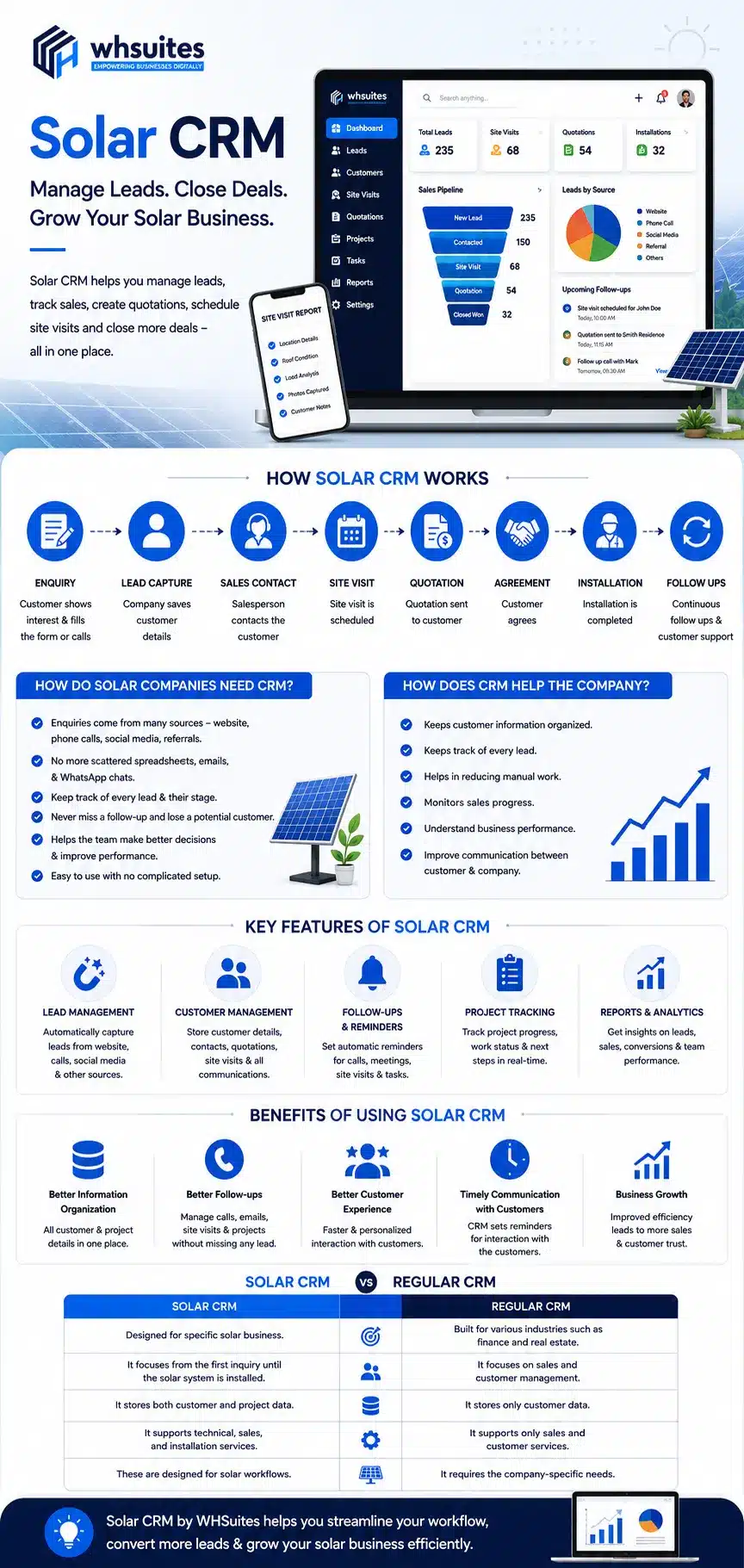
| Enquiry→Company saves the customer details→Salesperson will contact customer→Sites visit is scheduled→Quotation sent to customer→Customer agrees→Installation is completed→Follow ups |
Why do Solar Companies Need CRM?
Companies receive enquiries from many sources such as websites, phone calls, social media, and referrals. So there is no need to store information on hundreds of spreadsheets when you can store it in a centralized database. It is very difficult to remember which customer needs to follow up and which customer is at what stage. CRM keeps track of all information.
Without the CRM, the team may forget to follow up with the customer, which will result in losing track of the project and failing to communicate with the customer on time. The CRM will help the team to make better decisions and improve performance. There is no complicated setup or learning process for the Solar CRM.
How Does CRM Help the Company?
- It keeps the customer information organized.
- It keeps track of every lead.
- It helps in reducing manual work.
- Monitors sales progress.
- Understand business performance.
- Improve communication between customer and company.
Key features of Solar CRM:
- Lead Management- It is one of the most important features of a CRM. If a customer fills the enquiry form, the system will automatically save details.
- Customer Management- Once a customer fills the enquiry form, it allows businesses to store customer-related information like name, contact number, quotations, and site visit reports.
- Follow-ups & reminders- Follow-ups are very important in any solar CRM. The CRM will automatically set reminders for scheduled meetings, site visits, or tasks.
- Project tracking- It keeps track of the project, how much work is done, or what steps are required to be followed next.
Benefits of using CRM:
- Better information organization- A CRM stores all the details of a customer in a single database instead of keeping it in different spreadsheets and makes it easier to access the data.
- Better follow-ups- With the help of CRM, the team can manage calls, emails, site visits, and project details on time without missing any lead.
- Better customer experience- It allows faster and direct interaction with the customer as it saves the contact information of a customer.
- Timely communication with customers- CRM sets reminders for interaction with the customers.
Solar CRM vs Regular CRM:
Both CRMs are designed to manage customer relationships, but they are used for different purposes.
Regular CRM: A Regular CRM is designed for a wide range of industries like finance, health care, and real estate. But it does not include features that are specified for a solar company.
Solar CRM: A Solar CRM includes all the features that are essential for a solar company. It consists of the tools that completely support the sales and installation process.
| REGULAR CRM | SOLAR CRM |
| Built for various industries such as finance and real estate. | Designed for specific solar business |
| It focuses on sales and customer management. | It focuses from the first inquiry until the solar system is installed. |
| It stores only customer data | It stores both customer and project data. |
| It supports only sales and customer services. | It supports technical, sales, and installation services. |
| It requires the company-specific needs | These are designed for solar workflows |
Conclusion:
A solar CRM is an essential tool for every solar business. It helps the company to track leads, sales, projects, and customer relationships from first enquiry to after-sales support. It keeps all the details in one centralized database that reduces manual work. A solar CRM improves communication and makes sure that no lead will be missed.
FAQs about Solar CRM:
Q1. Why is the CRM required in the solar industry?
Solar companies receive enquiries from various sites. Instead of storing data in multiple sheets, Solar companies store the data in a CRM. CRM keeps track of all information.
Q2. Can small industries also use a CRM?
Yes, a CRM is beneficial for all kinds of businesses. It keeps track of leads, customer information, and improves follow-ups.
Q3. Does CRM also improve customer service?
CRM records all the customer details and project details in one place, which makes it easier for the industry to respond faster and provide better support.
Q4. Does Solar CRM also help the business to grow?
Solar CRM helps in growing the business as it reduces missed follow-ups, improves lead management, and provides the customer a better experience.
Q5. Is there any need for technical skills to use CRM?
No, there are no requirements for technical skills to use a CRM, as it is user-friendly software. Basic computer knowledge is enough to manage customer leads and track project progress.