
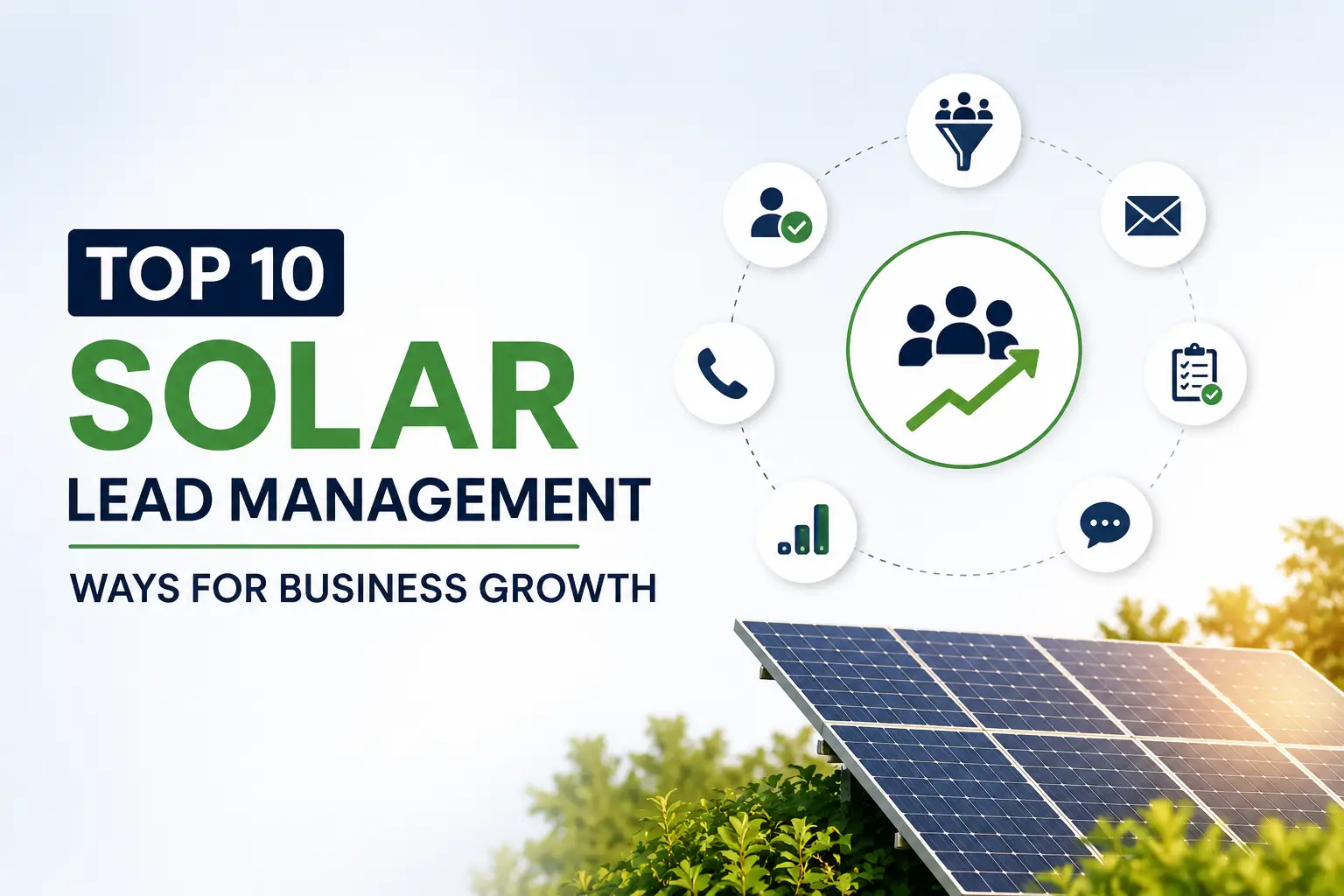
Top 10 Solar Lead Management Ways for Business Growth: Creating solar leads is only a part of the job; it’s when they begin coming in that the real work kicks into high gear. A homeowner sends an inquiry for a quote, a business owner requests rates for installation, or someone fills out your form after clicking on your solar ads.
Once these leads begin pouring in, what happens next?
If the lead lingers in an email inbox for hours, is assigned hours later, is approached with inconsistent sales strategies, or is lost in translation from marketing to sales, even a campaign that brings in tons of opportunities may not yield successful outcomes.
Effective lead management directly correlates to a solar business’s ability to get from the original inquiry all the way to a site visit, proposal, installation, and happy lifelong customer. It doesn’t always take increasing lead volume; instead, it takes increasing your attention and efforts toward already existing leads.
Try these 10 effective solar lead management strategies that, when employed, can lead your business toward faster responses, better qualification, more effective follow-up, and a bigger bottom line.
Why Your Solar Company Needs Lead Management
Most solar leads aren’t ready to buy on the spot. After all, customers first have many questions:
- How much will it cost to install? What about my finances and any incentive programs that apply to me?
- How much money will I save, and how long until my ROI?
And with all these to consider, some prospects aren’t interested yet. But that doesn’t mean your lead is not valuable. Without proper lead management, the sales team might lose leads to :
- Lack of follow-ups on qualified leads
- Failure to attend to quality leads (as it is time-consuming on the part of sales reps)
- Slow responses on fresh leads
- Loss of the record of a lead conversation
- Unintentional sharing of inappropriate content or outdated information
- Loss of the opportunity to recover potential sales from older leads
A qualified lead management system ensures that each lead undergoes a complete journey to be a satisfied customer.
1. Get All Your Leads in One Place
Most solar businesses will be getting a large variety of leads: Google ads, social media ads, their website, an existing referral program, lead capture forms/landing pages, incoming phone calls, email marketing, offline events – the list can go on. It usually becomes the initial concern and issue when you start storing that data in multiple places. A lead’s email, on a spreadsheet, on a sales rep’s personal phone, inside an ads campaign, somewhere on the website- the opportunity gets lost.
Having a system in place that collects all your leads and aggregates them is the #1 solution!
Your central database can record customer data such as:
- Client/customer name
- Client contact information
- Source of the lead
- Customer home address/location
- Property type
- Solar needs/questions
- Estimated project value
- Lead status (e.g., contact, qualified, closed-won, closed-lost)
- Assign a sales rep to that lead. No more wondering “Where did this lead go?”
2. Respond To New Solar Leads Quickly
Speed is of the essence.
When a person seeks solar installation, they likely contacted several companies concurrently. If your company doesn’t respond within the span of several hours or days, another solar installer has possibly already taken hold of the conversation.
Determine and assign your team to promptly respond. Create a set time to respond to your leads and designate a responsible individual on your team for each lead.
Here is how a CRM can benefit from its automation:
- Send automatic notification emails about new leads to the designated representatives.
- Assign inquiries to sales representatives appropriately.
- Generate subsequent action plans.
- Send the prospect an automated reply acknowledging their submission.
- Highlighting leads where there has yet to be a contact attempt from any sales representative.
- Automation should by no means duplicate human correspondence.
Its aim is quite merely for you not to leave a viable leads simply because nobody managed to notice their inquiry to attend to.
3. Qualify Leads Before You Waste Too Much Time on the Wrong Ones.
Everyone searching for information online about solar systems has a different level of interest and readiness. Someone may be ready to install a solar system next month, while another is still learning about their options for the first time.
Someone else might have property that is not conducive to a solar panel installation of the necessary size and output for their needs.
This is why lead qualification is important. Design a straightforward qualification procedure that focuses on what matters for your company, such as Property type (residential/commercial), Geographic area, Energy use per month, Property ownership (whether renting/owned), expected system size needed, System implementation schedule, Finances/budget, Willingness to purchase, or motivation for the purchase.
Then, you can segment leads into hot, warm, or cold, or use your own qualification statuses. You are unable to make your team prioritise their time instead of handling all incoming requests identically.
4. Leverage Lead Scoring to Pinpoint High-Intent Prospects
Qualification will tell you if a lead matches your ICP, but lead scoring will help you identify that leads intent level.
A solar lead might have a lead score that gives them points in the following categories: requesting a quote, setting up an appointment, asking about payment plans, visiting price and product pages, downloading a guide about installing solar panels, responding to sales emails.
Your homepage visitor, of course, will have lower buying intent than your prospect who has requested an in-home consultation and has asked you about your installation timeline. These clues can all be added to your CRM for follow-up priority.
5. Have a Standardised Solar Sales Pipeline
When a member of the sales team does not know how to move a lead, it makes it difficult for them to take control and follow up properly.
Having a defined sales pipeline will give the entire sales team a clear outline of where a lead stands in the sales process and how it is progressing along their customer journey. A few examples of pipeline stages for a solar company include:
New Lead → Contacted → Qualified → Consultation Scheduled → Site Assessment → Proposal Sent → Negotiation → Won/Lost
These stages will vary from each company and sales process, yet the underlying theme is still the same- each lead has to have a defined status at all times. This gives sales managers quick insight into how many new leads are inbound, how many leads are qualified, how many site appointments are being scheduled, how many proposals have been sent, where deals are falling through, and what the possible revenue is at any point during the sales cycle. Having a visual solar pipeline transforms disparate leads into easily manipulable opportunities within the sales team.
6. Design A Follow-Up Plan Where You Don’t Rely on Your Memory
Here’s a scenario we often hear about in the solar sales world:
Prospect receives a proposal.
“ I’ll take a look at that and get back to you,” the prospect says.
Salesperson marks their calendar to call in 2 days.
The next client comes. Next deal to be worked up. You get caught up.
2 days turn into 2 weeks.
Prospect ends up going with another installer.
It wasn’t necessarily because of the proposal. It was because of the lack of a follow-up process.
Have standardised follow-ups to utilize for each stage of the buyer journey. Some ideas:
- After inquiry: Ensure the lead received what they asked for and make the initial call.
- After consultation: Provide value and reaffirm when the next steps will be.
- After the site assessment: Give them an estimate as to when the proposal will be ready.
- After the proposal: Touch base to make sure they received it, had any questions, etc.
- If no reply: initiate a re-engagement sequence that doesn’t fall off a shelf.
Using your CRM software to send reminders or schedule follow-up tasks will ensure each qualified opportunity has something scheduled.
7. Link Marketing Leads to Sales Results
The marketing team has a good idea of which campaigns produce inquiries. The sales team understands which leads convert to customers. The real benefit lies in bridging that gap.
Imagine you find that:
- Google Ads produce the highest number of inquiries
- Organic Search leads not so many but better prospects
- Referral leads highest closing rate
- One specific commercial campaign leads to the largest deals, which becomes far more insightful than “which campaign generated x leads” Google Ads leads, organic search leads
- It gives you a chance to measure marketing on more meaningful metrics-quality, closure, revenue, and not just volume.
This will help you to make more effective decisions about your marketing spending.
8. Segment Solar Leads and Personalise Your Follow-Ups
Not all solar prospects require the same.
The questions from a homeowner thinking about a rooftop system are quite different from those of a commercial property owner investigating a large installation.
Two residential prospects can be worlds apart.
That is the reason why lead segmentation is so important.
You can organise leads based on:
- Residential or commercial requirements
- Location
- System size
- Buying stage
- Financing interest
- Lead source
- Installation timeline
- Product or service requirements
Once leads are segmented, your outreach can be more targeted.
As an illustration, a homeowner who is considering installing solar might be interested in potential savings, how long the process will take, and cost.
A commercial prospect might be more interested in the project size, operating costs, ROI, installation planning, etc.
Relevant communication will seem helpful. A blanketed communication will seem like marketing.
9. Have a comprehensive record of all interactions with a lead
How frustrating for customers to explain the same story multiple times to different people within a company? Poor use of business resources, too. Every lead should contain a comprehensive record of every interaction a customer has with each member of your sales team, including:
- Calls Emails
- Meetings Notes
- Site assessment
- Quotes
- Client questions
- Follow-up items
- Prior sales conversations
Now anyone can easily find all information on a lead at the push of a button and be informed before even saying a word.
This is critical as you scale and other members of the sales team get involved with a lead.
The customer is treated with consistency, and the sales reps are up to speed on the prior interactions.
10. Focus on the Metrics That Actually Contribute to Solar Sales Growth
Once you are tracking lead activity, they become infinitely more useful. Beyond simply answering “How many leads did we generate?” find the data about what happened to each lead that entered the mix.
Some key solar lead management metrics you should be measuring are
- Lead response time
- Lead qualification rate
- Lead-to-opportunity conversion rate
- Proposal-to-sale conversion rate
- Overall win rate
- Average sales cycle
- Cost per lead
- Customer acquisition cost
- Revenue by lead source
- Sales representative conversion rate
- Number of inactive leads
- Pipeline value
Knowing these metrics can shine a light on your bottlenecks. A low qualification rate indicates an issue with lead quality and the lead qualification process. If no leads are converting to proposals from qualified leads, something is broken in the sales process itself. If all proposals, then something needs to be addressed when it comes to the actual price of the proposal, any follow-up required by the sales rep, handling customer objections, or an overall unsatisfactory experience.
Those figures reveal what to investigate.
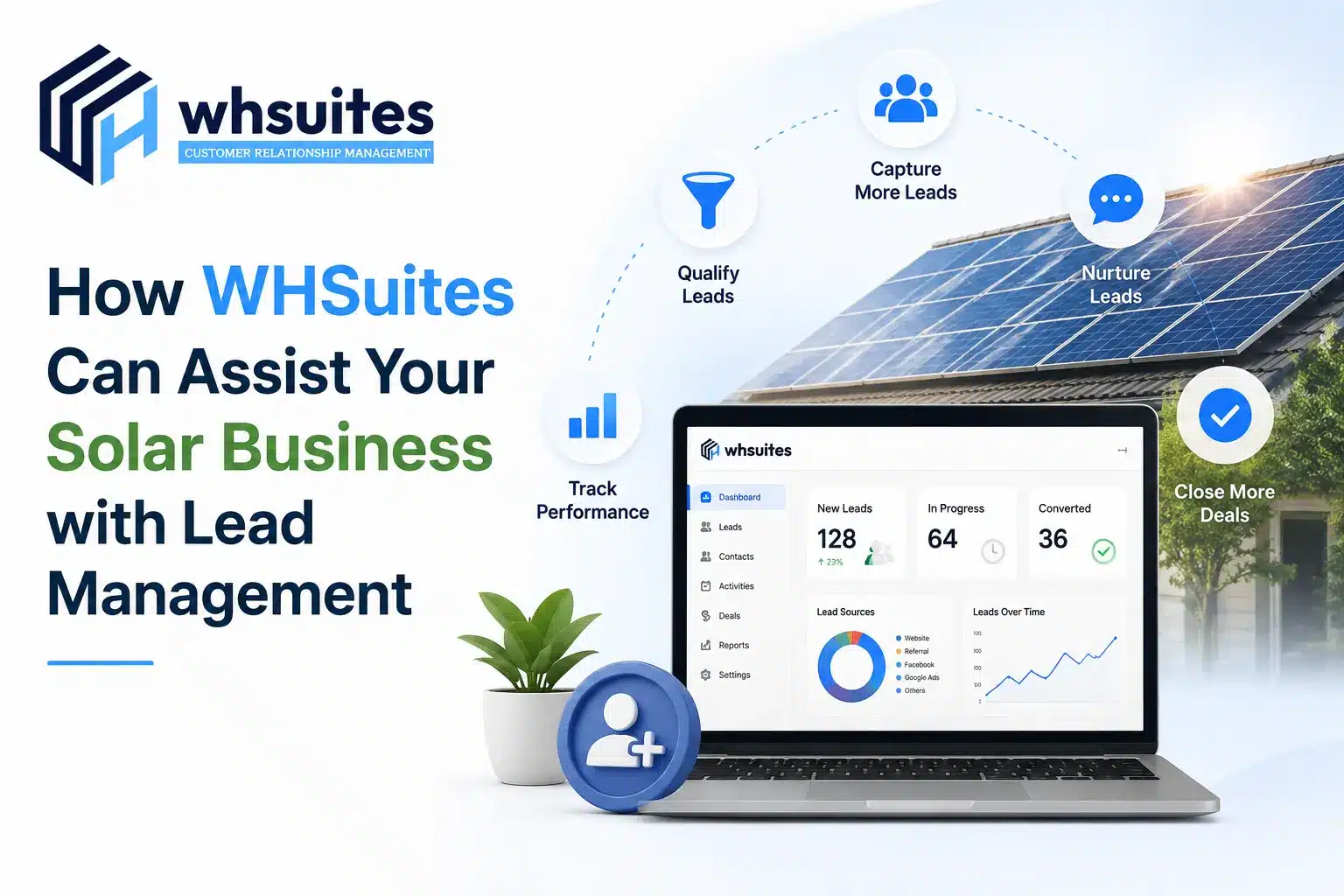
How WHSuites Can Assist Your Solar Business with Lead Management
Here’s how WHSuites can assist your solar business with lead management
As your solar business expands, effectively handling and nurturing new leads can become tricky
Although spreadsheets are convenient when first starting out, they become chaotic to manage with hundreds or thousands of new leads, several different sales reps, multiple lead sources, and endless follow-ups; spreadsheets quickly become impractical.
WHSuites acts as a comprehensive CRM for solar businesses, allowing for the centralisation and organisation of all your leads, management of sales pipelines, tracking of interactions, assignment of leads, scheduling of follow-ups, and performance reporting.
Rather than flicking between numerous spreadsheets, inboxes and tracking tools, your team has everything within one centralised hub of information to follow the lead through every stage of the funnel, such as;
New Inquiry → Automatic Lead Assignment → Sales Follow-Up → Qualification → Site Assessment → Proposal → Follow-Up → Closed Deal
With WHSuites, sales managers can obtain much clearer visibility into all pipeline activity and quickly see which opportunities are receiving much-needed attention. The greatest benefit will be not necessarily getting a broader list of CRM features, but actually achieving an adoptable and consistent process that you and your sales team can truly implement.
What Does a Healthy Process for Solar Lead Management Look Like?
You don’t need an elaborate 5-7 step process for leads. You need a process where every lead has ownership.
A solar lead workflow should be one which is the answer to these 4 questions every step of the way: Who owns this lead?
What has previously happened? What needs to occur now?
When does it need to occur by?
When your CRM can answer these questions, then your sales team aren’t wasting valuable minutes thinking about what has previously occurred; they are spending their time taking the leads to the close.
FAQ’s on Solar Lead Management Ways For Business Growth:
1. What is solar leads management?
Solar lead management is outlined as the collecting, managing, following up and converting leads who can be offered to set up customers that arrange with the leads and are reliable leads management, which is typically the initial follow-up till installation/order through the proposal phase to the closing stages.
2. Why is lead management so important for solar companies?
When purchasing solar, most homeowners do a lot of research, meetings, compare pricing, follow ups. Good lead management is about quickly addressing the concerns or issues of prospective clients, prioritising viable options, following up appropriately, and avoiding losing prospects due to incomplete or inadequate lead management and follow-ups.
3. How does a CRM benefit solar lead management?
A CRM integrates a customer’s details (lead information), their sales cycle, communications, pipeline information, follow up requirements. This helps solar sales teams have better access to each opportunity. Managers use CRM data to find lost sales, poor follow-up performance and sales potential at different points of the cycle.
4. What should a solar CRM track?
A solar CRM must provide information on the customer’s personal and property details, lead source, system capabilities of the building, estimated cost of the project and options to finance it, status on the sales ladder, communications used to connect to the customer, the site assessment notes, proposals for the system, appointments made in order to complete follow-ups, etc.
5. What kind of turnaround should a solar company respond to new leads?
As quickly as possible- especially for high-intent lead requests, like those requesting a quote or consultation. Alerts automatically notify the solar sales rep of the new lead and can be set up to automatically assign the new prospect.
6. How can solar companies get a sense of high-quality leads?
By considering: property type, location, project specifications, budget, installation timeline, and customer buying interest. Lead scoring will help solar businesses filter the hottest prospects that have shown signs of strong buyer intent via quote requests, consulting bookings, and repeated website visits.
7. How does automated follow-up save a solar sales rep time?
Automated follow-up makes it much more likely that a good lead will not be left behind. Scheduling automated reminders or tasks and workflow automation for your follow-up campaigns allows your sales reps to invest their time with those who will most likely buy while never letting a solid opportunity slip through the cracks.
8. What’s the most critical lead management metrics for solar?
Important lead management metrics include: response time, qualification rate, lead-to-opportunity conversion, proposal-to-sale conversion, win rate, average sales cycle, customer acquisition cost, revenue by lead source, pipeline value, and salesperson performance.
9. Can a CRM manage leads from Google Ads?
The CRM is a tool capable of tracking leads from many diverse sources, including those generated through paid campaigns on Google, PPC on search engines or other pay-per- click ads, SEO through organic search, referrals, and social networking site campaigns. It enables business users to analyse the best sources of those leads that result in purchases, among others.
10. How can WHSuites help solar companies with lead management?
WHSuites brings lead management, sales pipeline, follow-up activities, customer communication, and reporting under one roof. It provides your team with an organised approach to managing opportunities and allows your sales managers to have improved insights into pipeline activity and team execution.
Convert More Solar Leads Into Customers
You don’t need thousands of new leads a month for your solar business to thrive. In many cases, a major opportunity may have already been passed. The lead you didn’t call soon enough.
The proposal you forgot to follow up on.
The fully qualified prospect buried in a spreadsheet. An old lead you lost contact with, but that could have converted with a little effort today. The key to capturing those opportunities is a robust lead management process. A CRM such as WHSuites can house all of your leads – capturing, qualifying, and assigning them, in addition to managing follow-up communications, pipeline visibility, customer interactions and detailed reporting.
Growth in solar doesn’t come from more leads-it comes from managing the leads you have with the attention they deserve.