
Planning to bring a CRM into your solar business? That’s a smart move, but choosing the CRM with the longest feature list is not the right solution; you need a CRM that matches your daily work operations. After all, a CRM is only useful when it actually makes your team’s work easier instead of adding another complicated system to manage.
From capturing leads to scheduling site surveys or preparing quotations to staying connected with customers, a solar business has several moving parts. The right CRM should bring all these activities together to help your team stay organized and give you a clear view of what’s happening at every stage of the sales journey.
So, before you invest in any CRM, take a look at things to consider while choosing any solar CRM that fits your business today and can support you in future.
What exactly is Solar CRM?
A Solar CRM (Customer Relationship Management) is generally a system that helps solar companies manage their customers, leads and sales work in one place. With this, you don’t need to keep lead details in Excel, customer conversations on WhatsApp, quotations in emails and follow-up notes in different places. You can manage everything through a single system of CRM.
Key Features of a Solar CRM
- Lead Management
- Lead Assignment
- Sales Pipeline Management
- Site Survey Management
- Follow-Up Automation
- Customer Communication
- Task & Appointment Management
- Document Management
- Mobile Access
- Role-Based Access
What Things to Consider While Choosing Any Solar CRM?
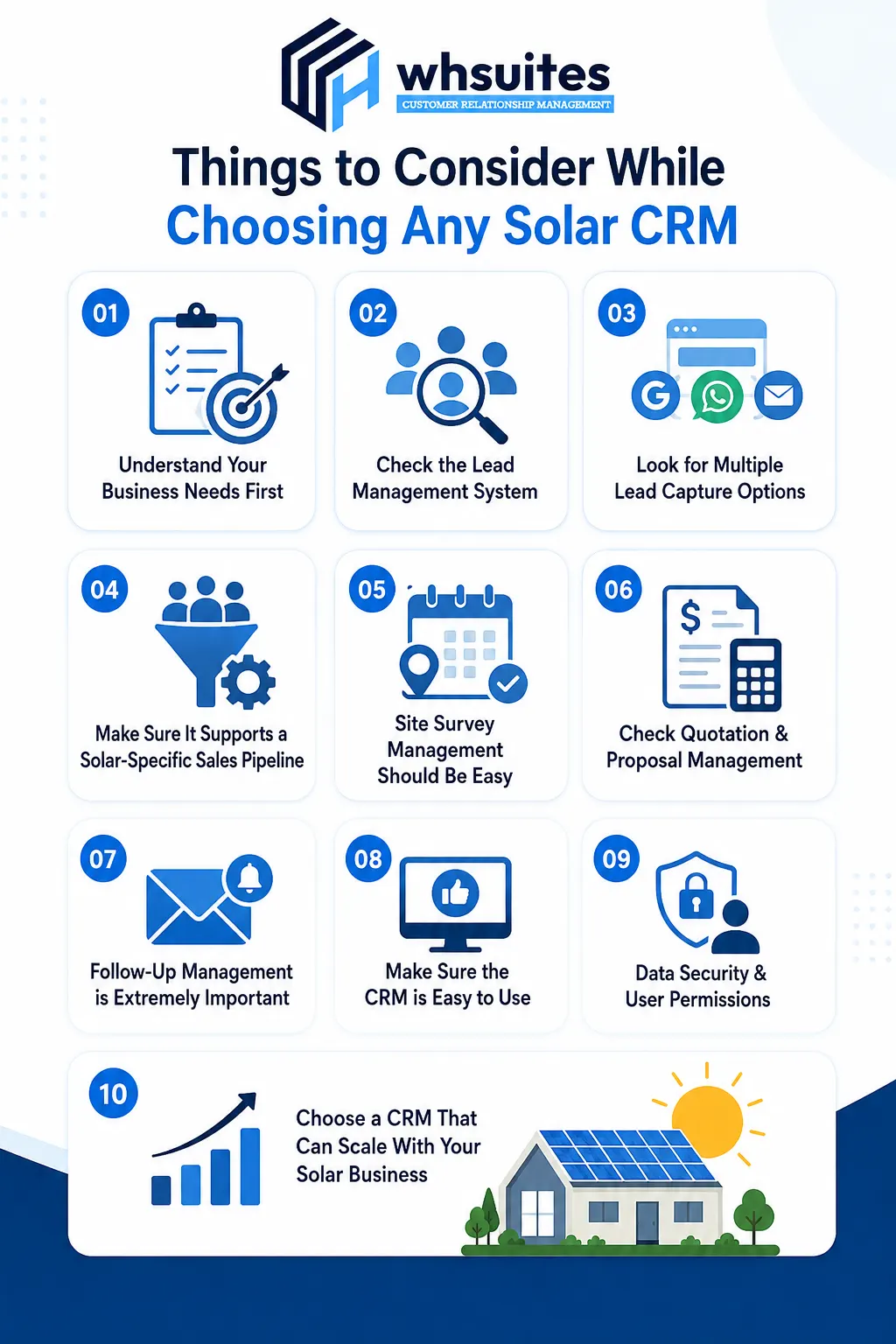
- Understand Your Business Requirements First
- Check the Lead Management System
- Look for Multiple Lead Capture Options
- Make Sure It Supports a Solar-Specific Sales Pipeline
- Site Survey Management Should Be Easy
- Check Quotation and Proposal Management
- Follow-Up Management is Extremely Important
- Make Sure the CRM is Easy to Use
Understand Your Business Requirements First
Before you begin comparing multiple CRMs, first understand what your solar business actually needs. Different solar companies have different sales processes, team structures, customer bases, and workflows. Consider the following:
- Identify your current challenges
- Consider your team size
- Understand your sales process
- Identify your lead sources
- Think about future requirements
- Set a realistic budget
- Involve your team
Check the Lead Management System
For a solar business, leads are the core point of their sales journey. With lead management, even your strong marketing campaigns can result in missed opportunities. That’s why always check that your CRM has a proper lead management system. It helps you:
- Capture complete lead information
- Track lead status
- Assign leads to sales representatives
- Record lead sources
- Maintain communication history
- Prioritize leads
- Track lost leads
- Monitor response time
Look for Multiple Lead Capture Options
Solar leads mostly come from several different sources. If your team has to manually enter every enquiry into the CRM, it can consume time and increase the possibility of errors. Before choosing a CRM for your solar business, always check whether it can connect with the platforms you already use.
Look for options such as:
- Website integration
- Google Ads integration
- WhatsApp Integration
- Email Integration
- API or third-party integration
- Referral tracking
Solar-Specific Sales Pipeline
When it comes to solar, sales don’t happen overnight. A customer can take time to make a final purchase decision, and this involves multiple stages like enquiry submission, a call to the sales team, scheduling a site survey and more. When choosing a CRM, always look for solar-specific sales pipeline and features:
- Custom sales stages
- Visual pipeline
- Deal tracking
- Stage-based tasks
- Lost deal tracking
- Sales forecasting
- Pipeline reports
Site Survey Management Should Be Easy
Site surveys are the most important part of the solar sales and installation process. If you manage them through WhatsApp groups, phone calls or spreadsheets, it can quickly become confusing, especially when you have multiple surveyors and locations.
Your Solar CRM must have some useful features, such as:
- Survey scheduling
- Surveyor assignment
- Appointment reminders
- Customer location
- Survey status
- Site photographs
- Technical notes
- Survey reports
Check Quotation and Proposal Management
Once the customer is qualified and the site survey is complete, quotation management becomes an important part of the sales process. Always look for CRM features that help with:
- Quotation creation
- System details
- Pricing management
- Payment terms
- Warranty information
- Proposal templates
- Quotation tracking
- Follow-up reminders
- Revision management
- Document storage
Follow-Up Management is Extremely Important
A customer may be interested in solar but still takes time to make a decision. At that time, consistent follow-up becomes very important. Always consider a CRM that helps your team:
- Set follow-up reminders
- Schedule future activities
- Automate routine reminders
- Track previous interactions
- Identify overdue follow-ups
- Prioritize hot leads
Make Sure the CRM is Easy to Use
This is one of the most important things to consider and one that businesses often overlook. A CRM can have dozens of features, but if your sales team finds it complicated, they may avoid using it consistently.
Before making a final decision, always check:
- Simple navigation
- Easy lead entry
- Quick updates
- Simple task management
- Mobile accessibility
- Minimal training requirements
- User adoption
Most Common Mistakes to Avoid When Choosing a Solar CRM
A solar CRM makes your sales process more organized, but only if you choose the right one. Sometimes, we may select the CRM based on a single consideration. Let’s see what common mistakes we should avoid while choosing a CRM for a solar business.
- Choosing a CRM just because it has more features
- Choosing the cheapest CRM without checking its value
- Ignoring your actual sales process
- Choosing a generic CRM without checking solar requirements
- Ignoring lead capture and integration options
- Forgetting about follow-up management
- Not testing the CRM before buying
Which CRM is Best for Solar Businesses?
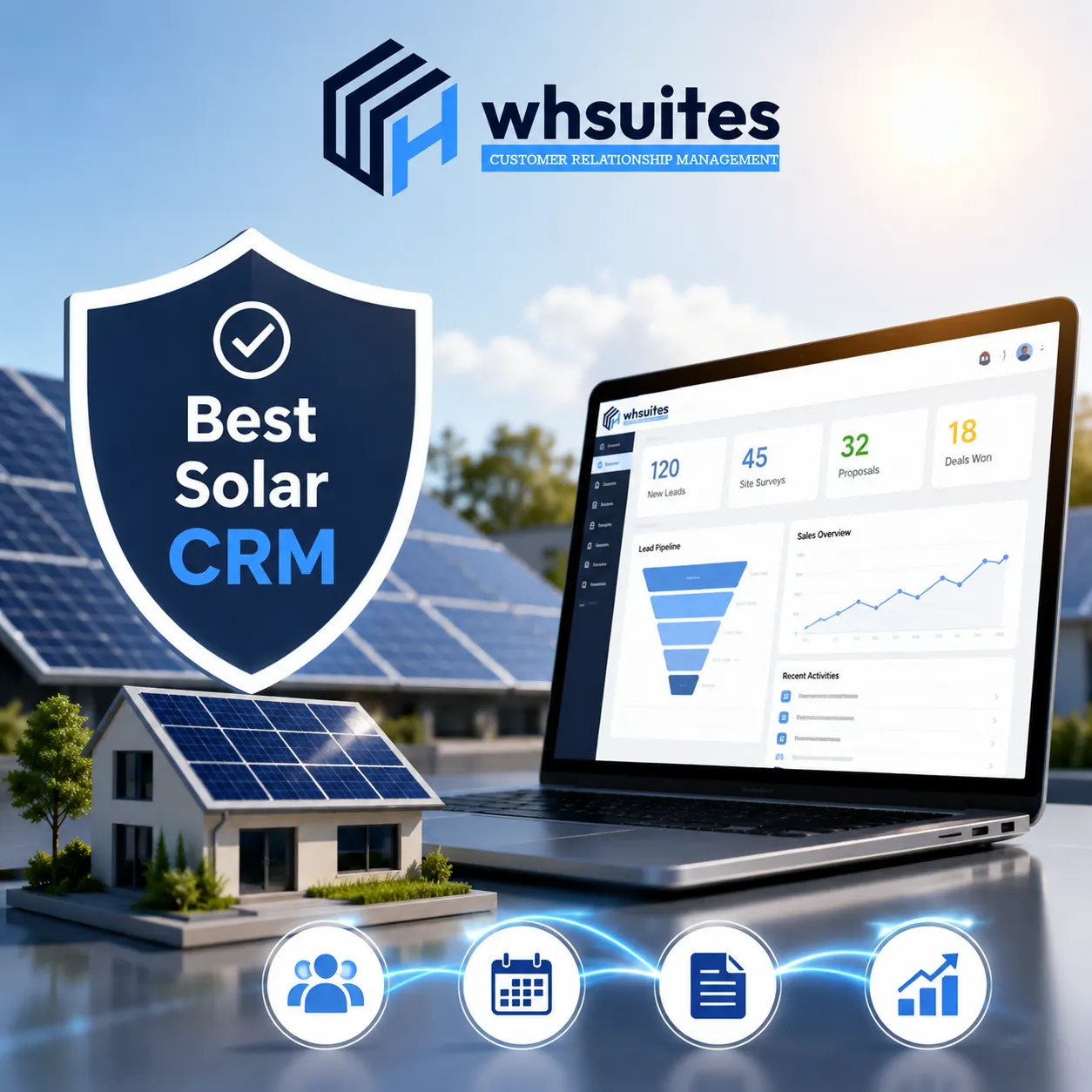
If you are genuinely looking for a CRM specifically suited to solar businesses, WHSuites Solar CRM can be a perfect option to consider. It is designed to help solar companies manage their sales and customer operations from a centralized platform rather than relying on spreadsheets, scattered messages and multiple disconnected tools.
Frequently Asked Questions about Things to Consider While Choosing Any Solar CRM
What if we choose a general CRM for a solar business?
Yes, you can choose a general CRM, but only if your requirements are limited to basic lead, contact and sales management. However, a solar business requires additional workflows for site surveys, solar quotations, project tracking, installation and after-sales service.
Should a solar CRM support automated follow-ups?
Yes, automated follow-up is useful for solar businesses. Customers may take time to make a final purchase decision. With automated reminders and workflows, your sales team can follow up at the right time and reduce the chances of promising leads being forgotten.
How can your CRM help with solar quotations?
A CRM can centralize customer and project information, making it easier for the sales team to prepare and manage quotations.
How to know whether a solar CRM can scale with my business?
First of all, look beyond your current requirements and check whether the CRM can support your future growth or not. Consider a CRM’s ability to handle more users, leads, customers, locations, sales teams and workflows.
What is the biggest mistake we should avoid while choosing a CRM for a solar business?
One of the biggest mistakes people make while choosing a CRM is that they choose based only on its price or feature list. Before making any final decision, you should evaluate usability, lead management, integration, automation, reporting, customization, security and how well it fits your actual solar sales process.
Can a solar CRM automatically assign leads to sales representatives?
Yes, many CRM platforms also support automatic lead assignment. Leads are distributed as per predefined rules such as location, lead source, product type, sales territory or salesperson availability.