
You spend weeks developing a marketing campaign, build an awesome offer, drive tens of thousands to your website, and are then left baffled: “Why aren’t people purchasing?”
The campaign isn’t always the problem. Sometimes the issue is what happens after someone clicks a link.
A prospect downloads an ebook, fills out a form, requests a demo, or clicks an email.
Then what?
Is there an immediate follow-up?
Does the prospect receive content based on what interested them?
Is the sales rep aware of what marketing messages the prospects have received?
When your CRM and marketing automation systems operate in siloed modes, answering these questions can be cumbersome. When your CRM and marketing automation systems collaborate, the customer’s journey and information are more streamlined.
Together, CRM and marketing automation combine customer data, campaign activity, lead nurturing, sales follow-up, and conversion data within a single integrated system. Rather than merely generating leads, your company can understand, nurture, recognize buying signals, and advance leads to sale.
That is when marketing can grow from just lead generation into a business development revenue stream.
Why CRM and Marketing Automation Work Better Together
In many cases, your B2B buyer might find your company via Google, see your website, download content, ignore your subsequent follow-up, come back weeks later to look at products, and then decide to ask for a consultation. In many cases, these interactions seem disparate. When a CRM and marketing automation solution “connect the dots,” your entire sales team will have a real picture of the buyer, covering every step from the original touchpoint and how it was tracked through website touchpoints, engagement activities, sales readiness, and on into revenue.
The real metric is not how many leads you capture; it’s how effective the leads are, and how well they translate into opportunity size and business value.
In other words, 1000 leads leading to 10 opportunities might not be better than 300 leads leading to 45. The real win is about bringing meaningful and quality prospects through the sales funnel to opportunity at scale.
Capture Every Lead Without Letting Good Prospects Slip Through the Cracks
New leads can arrive at any time of day or night. Someone could fill out a form at 11:45 PM, or request a demo on the weekend. A new contact could respond to a marketing e-mail at 10:30 AM when your salespeople are already on a call with a customer.
It may take many hours for that lead to be worked, by which time that prospect might no longer be warm or may have already moved on.
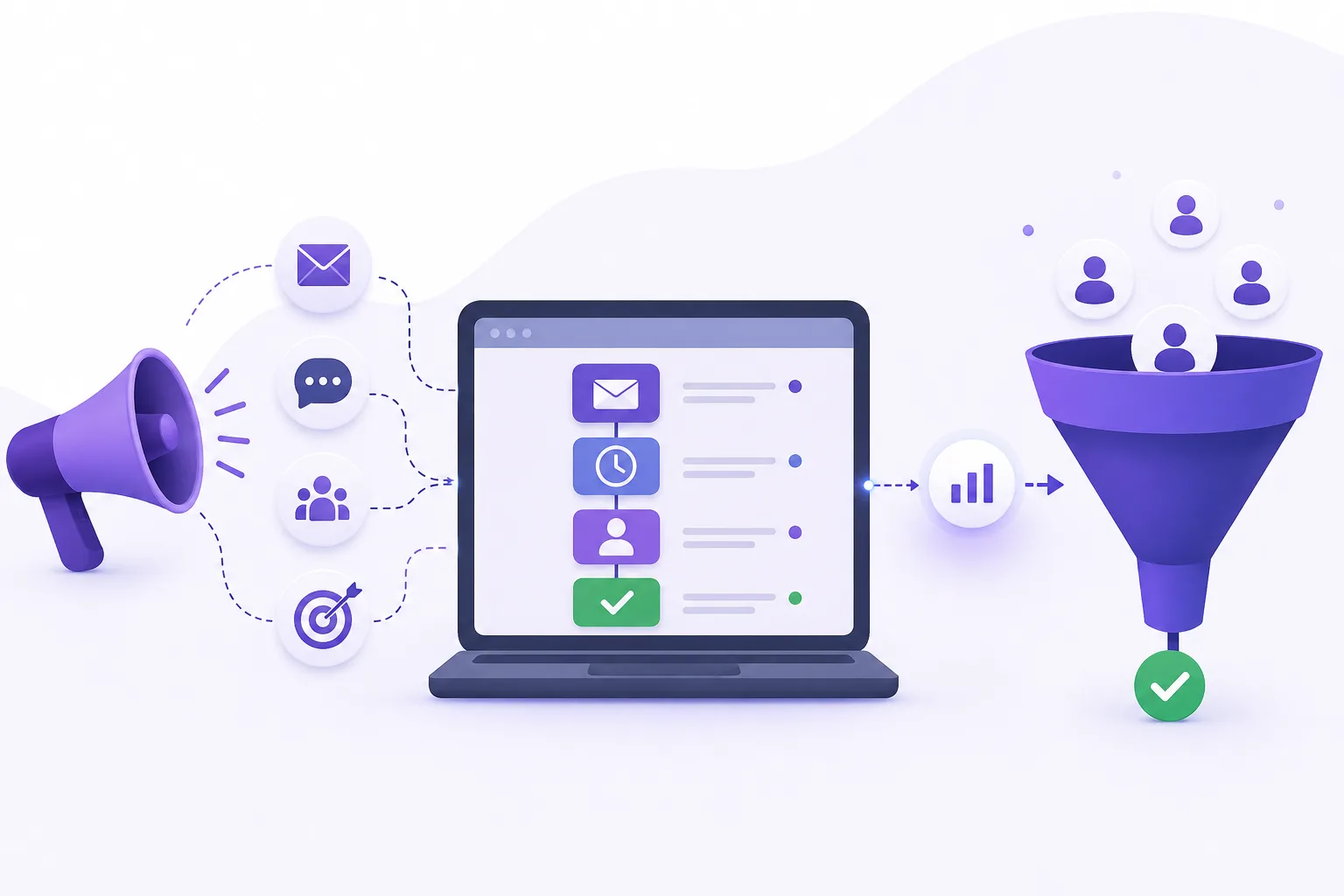
Marketing automation captures new leads without any manual intervention and can even initiate follow-up tasks. Your CRM stores your contact information as well as the campaign information.
For Example: Ad Landing Page Form Submission => CRM => Automated Email => Sales Follow-Up.
Instead of manually tracking this information between programs, the systems do it for you. This is even more important for rising businesses-since when a lot of opportunities come flooding in simultaneously, a sales representative will not know how quickly to attend to each one.
Know where each lead came from.
Everyone in the marketing world should be able to answer the question, “What marketing campaigns are actually giving us customers?”
Not clicks, not impressions, and not likes.
Tracking your CRM alongside your marketing automation program allows you to trace campaign activity through sales. You can compare lead sources from:
- Google Ads
- Organic search
- Social media
- Email marketing
- Landing pages
- Webinars
- Content downloads
- Referral programs
When you can do this, you’ll find your marketing budget becomes easier to justify. Instead of concluding, “This campaign brought us two thousand leads,”-you’ll begin to ask better questions: “how many of those two thousand leads have turned into opportunities?
Into customers?
How much revenue did the campaign drive?”
Don’t Talk to Everybody the Same Way
If there’s anything that makes marketing automated marketing, it’s blasting everyone with a canned email. The person who clicked through to download the beginner’s guide to our product shouldn’t necessarily receive the same email as people who asked for a demo consultation. The CRM can help marketing automation identify where a visitor is in the purchasing journey.
So: Freshlead: Learning “What exactly is X?”
High-intent prospect: Ready to purchase the demo. The content, in other words, reflects actual interaction a customer has. Relevance typically over volume anyway.
Keep Educating without Driving People Insane
A prospect is never ready to purchase the moment you reach out.
People might require three weeks or three months.
That should not mean these people “fall through.” Instead, they should enter a sequence of emails you didn’t get to the customer to keep moving. So:
Day 1: Welcome / I made the first step!
Day 3: Here is another of interesting information.
Day 14: Product or service information
Day 21: Consultation or demo invitation
The prospect never feels as if you are constantly knocking on the door. You answer concern and educate people, as well as respond to questions. The prospect finds there is certainly a good cause continue a discussion with you.
Use Lead Scoring to Qualify Buying Interest
Not every lead should be contacted by sales straight away. While opening an email may indicate an interest, visiting your pricing page, downloading a product guide, and requesting a demo should not go unnoticed. By assigning scores to leads based on various interaction factors that qualify buying intent, like email interaction, website visits, and resource downloads, you will be able to identify your most valuable prospects and allow your sales team to spend time on the highest potential leads.
Scorecard data points can be configured by each business based on importance. They can be the following points:
- Email interaction ( opens, clicks )
- Website visits ( to specific pages, frequency )
- Downloads (white papers, guides)
- View/visit to pricing page
- Request a demo
- Webinar attendance
- Submit form
When a lead’s score reaches a threshold set by the business, the CRM will automatically inform the sales team or assign the lead to a specific representative. This ensures that your sales representatives spend most of their time pursuing highly qualified leads.
Improve the Marketing to Sales Handoff
Many companies are successful at lead generation. However, the handover of these leads to the sales department can be problematic. A salesperson will simply receive a name and a telephone number and have no knowledge of whether or not a prospect is seeking a particular service. This is a missed opportunity. When integrated with marketing automation, sales representatives will be able to view what campaigns and marketing efforts the lead had previously been involved with prior to any sales contact. This might give the salesperson insight that the lead has previously:
- Downloaded a guide on a certain subject
- Opened several marketing e-mails
- Viewed a page describing a specific service
- Participated in a webinar
- Requested pricing information on a certain product or service
The conversation can now be opened with context instead of:
“So, how did you hear of us?”
That one change to your interaction can turn a cold sales call into a much warmer conversation.
Automate follow-ups without losing personal touch
- Sales reps are human. They forget.
- They get overbooked.
- They attend unexpected meetings.
- They have to drop everything to handle an urgent lead.
- A promising lead can feel like yesterday’s problem.
- Automation takes away the worry.
When a prospect asks for a demo, create an automated task that will follow up. If no one responded to your proposal, set up automated reminders to re-engage. When leads have gone dark, put them in an automated nurture campaign that will re-engage them.
- Automation takes care of the work.
- Your reps take care of the relationship.
- That’s golden.
Convert campaign data into revenue knowledge
Your marketing reports will tell you about the clicks, opens, impressions, and conversions related to your campaign efforts.
But those numbers aren’t the whole story.
The critical question is: What happens after the conversion? Let’s find it out:
What Happens After the Conversion?
Integrate CRM to Connect Campaign Metrics with revenue. It’s helpful to analyze:
- Leads generated
- Qualified Opportunities
- Conversion rates
- Deals created
- Deals won
- Revenue generated
- CAC (customer acquisition cost)
- Campaign ROI (return on investment).
Suddenly, the marketing team’s definition of success completely shifts!
A campaign isn’t successful anymore because people clicked on something it was successful because their interaction led to business results.
How WHSuites Helps Connect CRM and Marketing Automation
Managing campaigns, leads, follow-ups, and sales activity across a number of siloed tools is one surefire path to complexity. WHSuites connects those functions into one centralized business CRM system, allowing businesses to manage leads, track client engagement, manage sales opportunities, automate follow-ups, and track performance for a holistic perspective. Rather than asking two teams to work off of entirely separate excel sheets, we create a seamless transition from campaigns all the way to closing:
Campaigns → Lead Engagement → Qualification → Sales Follow-up → Opportunity → Customer
And the more you centralize those functions in an integrated solution like WHSuites, the greater ability you have to ensure that your marketing automation is helping you not just communicate but actually produce more sales for your business.
What a Connected CRM + Marketing Automation Journey looks like
It would go something like this:
- A lead clicks on a Google ad, lands on your website, and downloads a guide.
- The CRM captures the new lead and their details.
- An automation in your Marketing Automation solution fires and sends over a timely and helpful email.
- The lead accesses the service page on your website.

- Their engagement score goes up because of that interaction.
- They download a new case study at a later point, and your CRM identifies that they are a more likely buyer based on their buying journey and alerts their sales representative.
- The sales rep sees where their lead is in their buying process and reaches out with content that directly addresses their current stage and interest level.
- The lead books a meeting!
- The opportunity makes its way into the pipeline.
- The deal closes!
- Now marketing doesn’t only see that a campaign generated a lead, but that a campaign ultimately contributed to closing a deal.
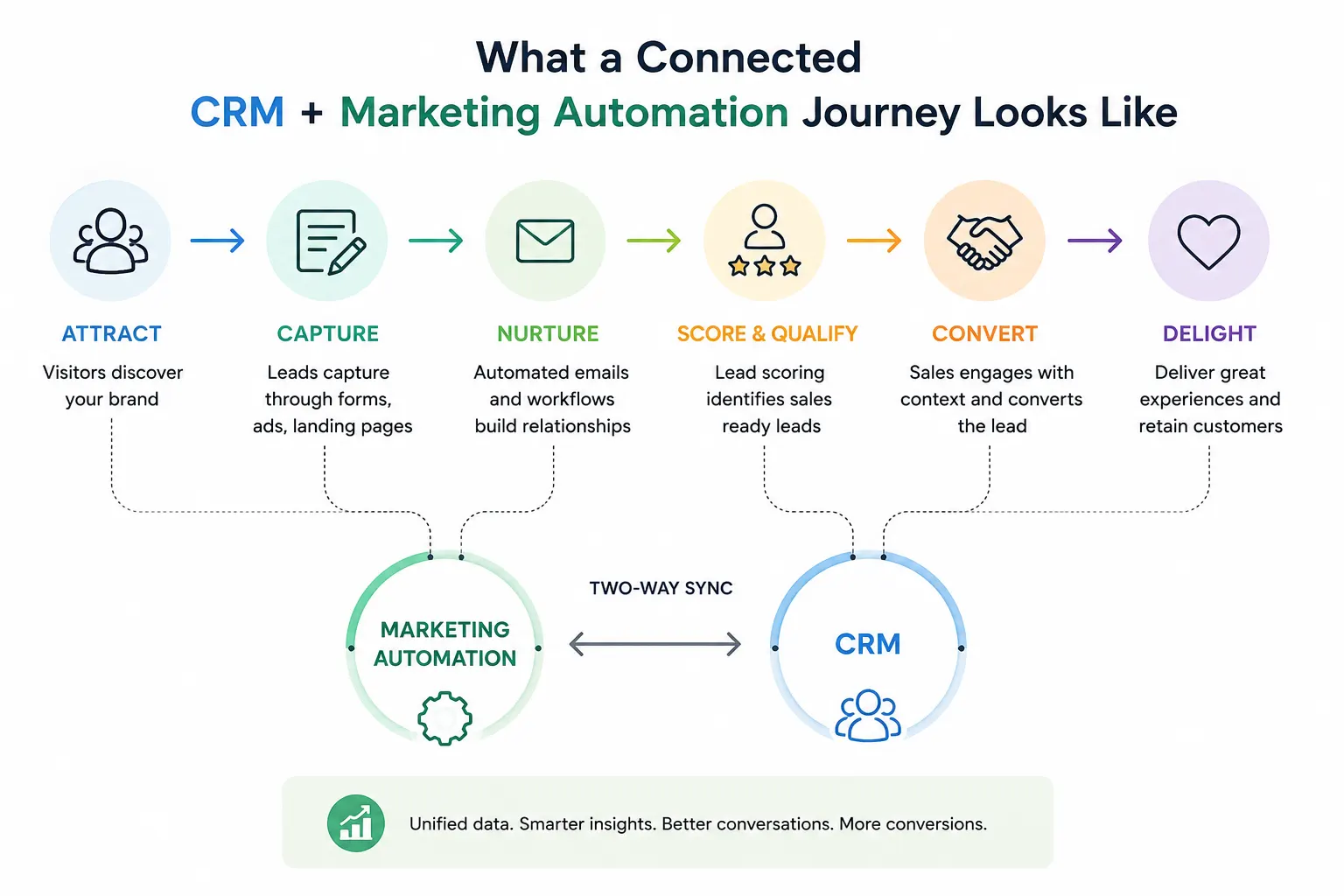
This is what tracking customer activity vs. tracking the customer journey looks like.
The “Goal” Shouldn’t Be More Automation – It Should Be Right Timing
- Automation is not the end-all-be-all for sending out a higher volume of messages, quicker. It is for sending the right message at the right time.
- A lead downloading a simple guide shouldn’t get a sales email immediately upon downloading, nor should someone requesting a demo get basic-level educational emails about your industry for weeks when they are clearly interested in learning more about your offering.
- The CRM gives you the context. The Marketing Automation takes over the execution.
Together, they give your business the ability to be proactive to customer behavior instead of reactive to each lead.
Frequently Asked Questions for CRM and Marketing Automation:
What are CRM and marketing automation?
CRM is where you track customer data and sales conversations, whereas Marketing Automation orchestrates various repetitive marketing functions, including sending emails, building lead- nurturing campaigns, and campaign workflows. They link together marketing activity and the success of customer transactions with the data in the CRM.
Why integrate marketing automation with CRM?
The integration of the two creates a single customer journey. The salesperson understands how engaged the lead is from marketing, and the marketing team is made privy to lead interactions and interest. This closes data gaps, and the sales team follows up appropriately, ensuring campaigns can be attributed to actual sales.
Can Marketing Automation increase the conversion rate?
If implemented with a clear strategy, yes! Automated nurturing, timely follow-up, personalization, and lead scoring, among others, will put leads through a more targeted communication campaign and into the hands of sales at a much higher state of purchase.
What is Lead scoring within marketing automation?
Lead scoring is an award system for prospect actions like visiting your website, requesting demos, downloading a piece of content, or even opening their emails. Once a prospect hits a threshold score, the CRM will recognize him as a sales-qualified lead.
How will CRM benefit the marketing team?
The CRM software would provide your marketing team with visibility into lead sources, customer details, campaign response data, and sales results of their outreach efforts. It could give your teams proof of which efforts deliver quality leads instead of the vanity metrics of clicks or just lead captures.
Will CRM and marketing automation benefit the sales teams?
Yes, it will. It would provide the sales teams with insight into a lead’s marketing campaign history, site activity, and prior touches. This could allow the rep to enter their conversation with more context, and follow-up messages could also be more relevant to the lead’s experiences.
What areas should my business automate first?
They advise customers to begin automating the 1st phase, which has highly visible impacts and is repetitive – such as lead capture, lead assignments, welcome emails, Follow-up reminders, lead nurturing, and sales notifications. Once the automation of these actions runs smoothly, they will also branch off into customer journey-driven campaigns customer initiated actions
How to measure the success of CRM and marketing automation?
They advise measuring based on outcomes instead of activity metrics. It’s important to measure such business impact areas as lead-to-opportunity conversion rates, number of qualified leads, length of sales cycle, win rates, amount of revenue attributed to campaigns, cost per customer, etc.
Turn Your Campaigns Into Conversations-And Conversations Into Conversions.
Marketing doesn’t have to end when someone fills out a form. That’s where the real customer journey is.
When CRM and marketing automation work together, your business can capture all leads, understand all communications, nurture prospects at precisely the right time, and give sales teams the insight they need to close more sales.
WHSuites helps you bring it all together so your marketing not only creates buzz-it creates a clear pathway to revenue.
Ready to connect your campaigns to your sales pipeline? Find out more about WHSuites and see how CRM + marketing automation can turn more leads into customers. Contact us today!