Commercial teams in the pharma industry depend on two basic figures: one is how many actual doctors a rep visits and the other is how many samples have been given out. Until today, companies have been using Excel files, WhatsApp chats, and year-end memories to monitor both of those aspects. The gap in using CRM to track doctor visits and distribution of samples is one of the hottest questions in pharma and medtech business. This article explains why traditional methods of tracking do not work, what one should know about factory visits and sample losses, and how CRM solutions like WHSuites narrow these gaps.
Why Doctor Visit Tracking Matters More Than Most Teams Realize
Field reps belonging to the pharma and medical sector visit on average no less than 7 clients per day, which makes them one of the most diligent workers in the field. Every such visit is either accurately tracked or forgotten thanks to a rep’s memory.
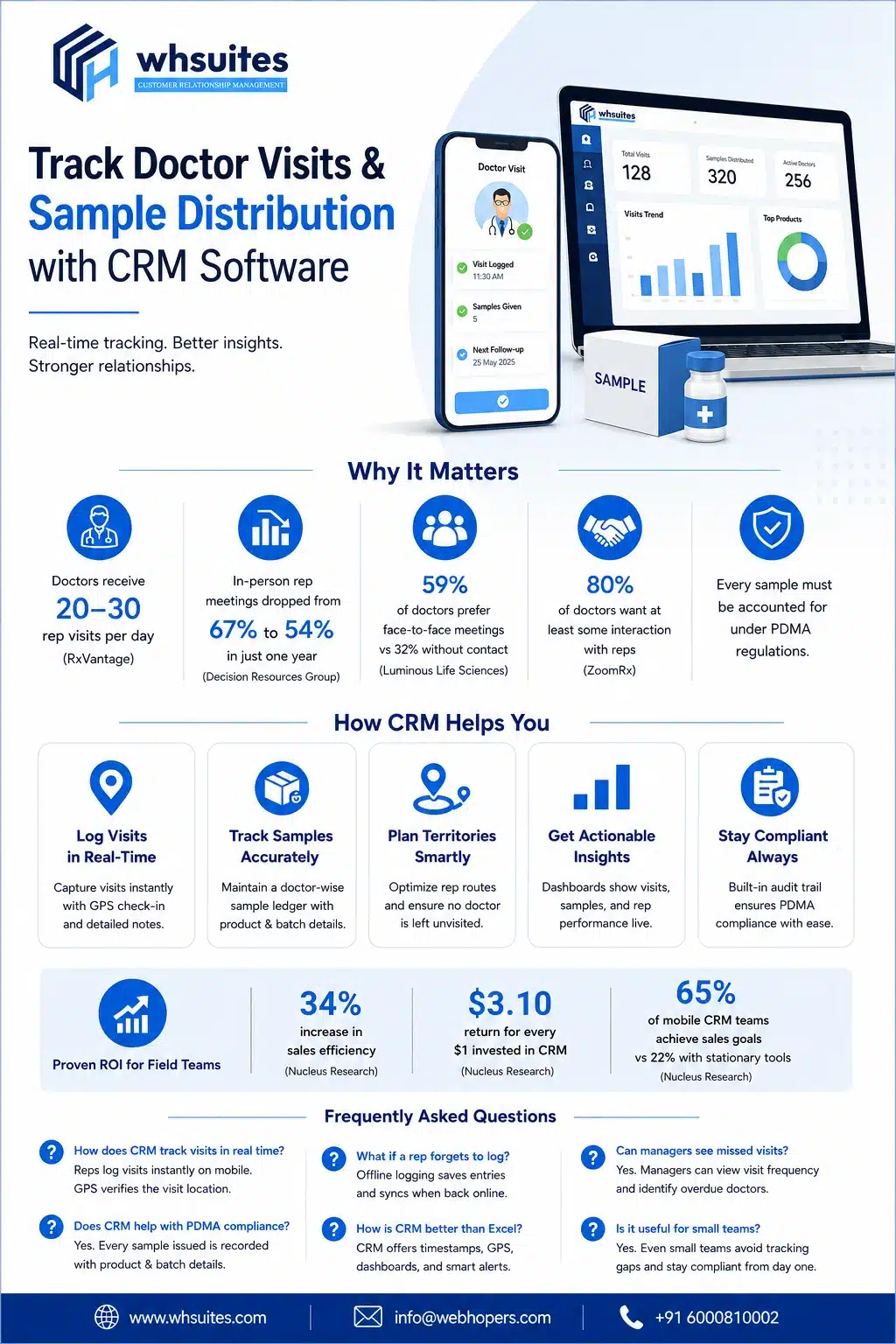
According to a survey of practice managers carried out for the purposes of RxVantage, it’s possible for a medical office to receive between 20 and 30 visits per day from drug representatives. Given this competition for the physician’s attention, a rep lacking records of previous visits and discussions made is easy to put aside.
Likewise, access is getting even harder. According to the ePharma Physician report from Decision Resources Group, the percentage of those willing to speak with reps in person dropped from 67% to 54% over the course of a year; moreover, the number of primary care doctors without any rep contact has increased from 21% to 40%. Fewer opportunities to visit physicians emphasize the importance of visit tracking since now every visit must be justified.
The benefits of being physically present are considerable. Studies carried out by Luminous Life Sciences reveal that the intention to prescribe among those having had face-to-face meetings with a rep was as high as 59% as opposed to only 32% for those who had had no contact. In such a situation, a failure to keep a record of the meeting will lower the chances for successful treatment implementation.
According to the results of a poll done by ZoomRx, even during the time of the pandemic, when meetings with pharmaceutical representatives were virtually impossible, approximately 80% of doctors desired at least some interaction with pharmaceutical representatives, while 14% wanted to increase the number of interactions they had with them. It could be seen that physicians were not rejecting drug representatives; instead, it was disorganization that made it impossible.
The Real Cost of Untracked Sample Distribution
Sample distribution and physician visits tracking are the two sides of the same non-compliance issue. According to the regulations put forward by the Prescription Drug Marketing Act, each drug sample given to a healthcare provider needs to be properly accounted for and any significant loss reported to the FDA, along with financial statements. This is federal law and it cannot be treated as a formality in paperwork.
Research conducted by QPharma indicated the absence of real-time tracking being one of the main sources of problems about sample distribution.
This is precisely the reason that IQVIA has made sample accountability a CRM-integrated process and not just a matter of recording data on worksheets as this has made available for companies an auditable record of all sample transactions linked to a specific doctor, representative, and visit.
Why Spreadsheets and Manual Logs Fall Short
No real-time access: managers get to learn about the activity during the day so that they can only get acquainted with the data on daily or weekly basis whiads to the situation when discrepancies and mia ssed follow-up actions are already outdated.
No unified source of truth, as visit notes are kept in one representative’s notebook while the sample account is kept in the memory of another representative reconciliation is impossible.
No accountability, as time-stamped documents proving the visit or the sample handoff do not exist; there is no way to verify how the visit or a sample transfer happened.
No ability to recognize patterns, as it is impossible for spreadsheets to indicate whether a doctor has not been visited for 30 days and whether the ratio of samples versus visits is wrong for a specific representative.
The dimensions of the issue are larger than most sales leaders realize. Field representatives utilize approximately 28% to 30% of their work week for genuine sales. The remainder is wasted to administration problems, manual reporting, and data entry, according to the findings made by the Salesforce State of Sales. As for pharmaceutical teams that have to deal with visits to doctors, samples, and compliance-related papers at the same time, this administration issue is even more serious.
How CRM Software Solves Doctor Visit Tracking and Sample Distribution Together
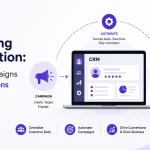
Pharmaceutical CRM software of the WHSuites type helps to solve the issue of visits to doctors and sample distribution.
1. Real-Time Visit Logging
Representatives can make use of their smartphones to log the doctor visit right after the meeting. During this period all information is gathered immediately while visiting a doctor. The GPS-based check-in system confirms that the visit has happened at the given clinic or hospital.
2. Doctor-Wise Sample Ledger
All samples given to the doctor in regard to a particular product and lot are registered at the moment of the visit creating a ledger corresponding to PDMA reconciliation needs without a need for a separate manual process.
3. Territory and Beat Planning
The system helps managers allocate territories and assign doctors to reps and supervisors can then check who has not made his/her visit or do his/her call because of inactivity or on the contrary, reps who keep calling the same doctors.
4. Manager Dashboards and Reporting
With the help of the field manager’s dashboard, supervisors do not have to wait for the reports at the end of the shift but can see how many visits have been made by the reps, the number of samples given, and which representatives have performed.
5. Compliance-Ready Audit Trail
Due to the timestamps showing the time of each visit and the entry of the samples, it is possible to establish an audit trail of both PDMA compliance and internal compliance audits.
What the Data Says About CRM ROI for Field Sales Teams
Moving from manual recording to CRM has its advantages that translate into numbers.
CRM implementation results in approximately a 34% increase in sales efficiency and a 42% increase in the accuracy of forecasts.
Traditionally, investing in CRM would yield $8.71 for every dollar spent; however, Nucleus Research’s current assessment estimates that a dollar spent currently yields $3.10 in return, which is still great ROI, especially for field teams that struggle with the manual tracking process.
Mobile CRM teams achieve 65% success in meeting sales goals, while those that use stationary tools only reach 22%, which is a substantial difference for sales managers who are reporting from the field and not the office.
How to Get Started with WHSuites
Identify your territories, and designate doctors, hospitals, and clinics to respective WHSuites employees.
Establish your sample catalog containing product, batch, and stock information to monitor supplies effectively.
Teach your employees to enter visit data in real time via field applications instead of doing so at the end of the day.
Utilize your manager dashboards to track overdue doctors, sample differences and employee productivity each week.
Generate PDMA-compliant reconciliation reports through CRM instead of doing so via spreadsheets.
Frequently Asked Questions
How does CRM software track doctor visits in real time?
Board members enter each visit immediately after it via their devices, storing the information about the conversation, samples transferred, and the next follow-up date and time. The GPS also verifies their visits.
Can CRM software help with PDMA compliance for drug samples?
Absolutely. The software records every sample issued to a doctor, along with the corresponding product and batch.
What happens if a rep forgets to log a visit or sample the same day?
Most CRM systems like WHSuites are equipped with a mobile application that allows for offline logging. A rep’s entry is stored on their device and automatically synchronized when he comes back online, thus preventing loss of data due to poor network signal in the field.
How is CRM-based tracking different from using Excel or a paper register?
A CRM allows time-stamping and attaching GPS coordinates for every entry, provides a live dashboard for the managers, and alerts about overdue doctors or discrepancies in samples, unlike any simple spreadsheet.
Can managers see which doctors haven’t been visited recently?
Yes. The CRM provides information about visit frequency per doctor in territory and route views, so managers can easily identify potential accounts that have not been visited on time.
Is a CRM like this useful for small pharma or medical device sales teams, not just large ones?
Yes. Even a company with a 5-member field team will lose track of unlogged visits and unrecorded samples easily. CRM resolves the issue from day one, which would otherwise become a bigger problem for the company as it grows.