
In today’s competitive world, getting a lead is very exciting. Isn’t it? But this is just the beginning. The real challenge is to nurture those leads. Convincing those leads until they are ready to buy. Since in B2B it takes time because there are many decisions to make, the company needs a smart system to keep track of all leads.
Prospects don’t purchase immediately. They explore. They compare. They leave, and sometimes they come back. Many businesses lose potential leads because they did not engage them in a timely. So, keeping in touch with those leads is very important.
At this point, marketing automation steps in as a powerful assistant and becomes a game changer.
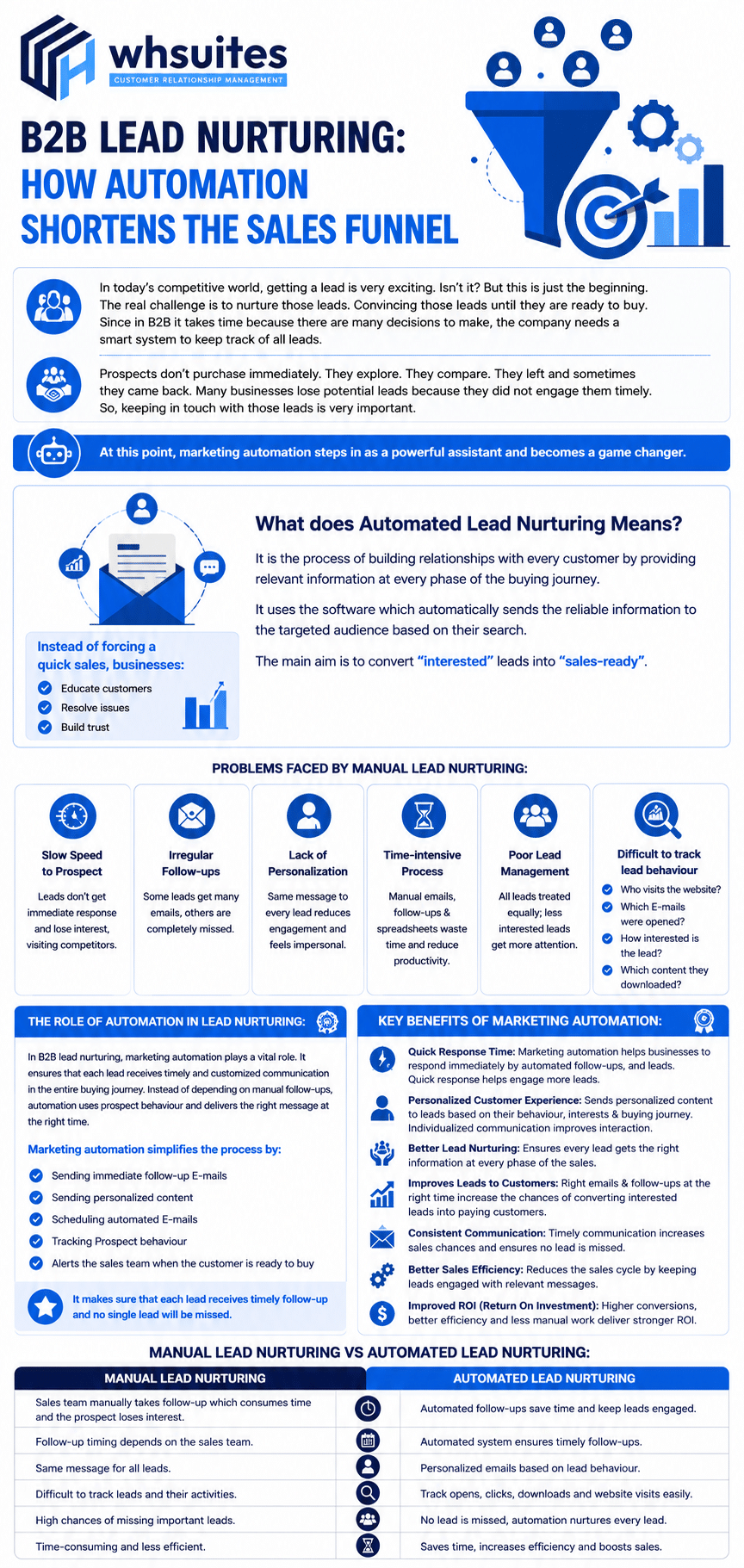
What does Automated Lead Nurturing mean?
It is the process of building relationships with every customer by providing relevant information at every phase of the buying journey. It uses software which automatically sends reliable information to the targeted audience based on their search. The main aim is to convert “interested” leads into “sales-ready”.
Instead of forcing a quick sale, businesses:
- Educate customers
- Resolve issues
- Build trust
Problems Faced by Manual Lead Nurturing:
Sales teams cannot handle every lead manually. As a result, many potential customers lose interest and visit competitors.
- Slow Speed to Prospect: Just imagine, a lead downloads the product guide and is ready to learn more. Instead of receiving an immediate response, the enquiry sits unnoticed in an inbox. As a result, the lead loses interest in your product and visits your competitor.
- Irregular follow-ups: Many leads receive a number of emails while others are completely unnoticed. Without a proper lead nurturing system, valuable prospects can easily be missed or lost to competitors.
- Lack of Personalisation: Each customer has different needs and interests. Delivering the same message to each lead reduces engagement and makes your outreach feel impersonal.
- Time-intensive process: It consumes time when the sales team sends emails, schedules follow-ups, and updates spreadsheets manually. Instead of closing deals, they spend many hours on repetitive administrative tasks. As a result, leads lose interest.
- Poor Lead Management: Every lead is not ready to purchase immediately. Manual systems treat every lead equally, where the sales team spends more time on those leads which are not highly interested. As a result, highly interested prospects are ignored.
- Difficult to track lead behaviour: Without automation, it is very difficult to know:
- Who visits the website?
- Which emails were opened?
- How interested is the lead?
- Which content they downloaded?
The Role of Automation in Lead Nurturing:
In B2B lead nurturing, marketing automation plays a vital role. It ensures that each lead receives timely and customized communication in the entire buying journey. Instead of depending on manual follow-ups, automation uses prospect behaviour and delivers the right message at the right time. Marketing automation simplifies the process by:
- Sending immediate follow-up E-mails
- Sending personalized content
- Scheduling automated E-mails
- Tracking Prospect behaviour
- Alerts the sales team when the customer is ready to buy
It makes sure that each lead receives timely follow-up and no single lead will be missed.
Key Benefits of Marketing Automation:
Automation helps businesses optimise repetitive tasks, improves customer interaction, and also increases sales efficiency.
- Quick Response Time: Marketing automation helps businesses to respond immediately through automated follow-ups and leads. Quick response helps the business to engage more leads without losing the potential prospects to competitors.
- Personalised Customer Experience: Marketing automation sends personalised content to leads based on their behaviour, interests and phase of the purchasing journey. Individualised communication improves interaction and builds stronger customer relationships.
- Better Lead Nurturing: Automation ensures that each lead gets proper information at every phase of the sales process, which helps the business to interact with more leads.
- Improves Leads to Customers: By sending the right emails and follow-ups at the right time increases the chances of converting interested leads into paying customers.
- Consistent Communication: Automation ensures timely communication with interested leads, which increases the chances of sales and makes sure that no lead is missed to competitors.
- Better Sales Efficiency: Automation helps in reducing the sales cycle by keeping customers engaged throughout the sales journey. Instead of interacting manually, automation sends relevant emails and follow-ups at the right time to the customer, which helps them to clear their doubts and make decisions immediately.
- Improved ROI(Return on Investment): Better efficiency, higher conversion rates and decreased manual work help businesses to enhance their marketing budget and get a stronger return on investment.
Manual Lead Nurturing vs Automated Lead Nurturing:
| Manual Lead Nurturing | Automated Lead Nurturing |
| The sales team manually takes follow-up, which consumes time, and the prospect loses interest to competitors. | Automated follow-ups ensure timely follow-ups and enhance engagement with prospects. |
| Response depends on the availability of the sales team. This results in delays in interaction. | Rapid responses are received by the prospects. |
| Lack of personalisation reduces the interest of prospects by sending the same e-mail to every single lead. | Sends personalised messages to every prospect based on their interest and stage of buying. |
| Manually sending e-mails and follow-ups is very time-consuming | Instant responses are delivered to prospects
Interact with content. |
| Longer sales cycles increase the chances of losing potential leads. | Faster conversion increases the sales chances. |
| Difficult to manage a large number of leads and increases manual workload. | Thousands of leads managed easily without increasing manual workload. |
Key Features of Marketing Automation in B2B Lead Nurturing:
Automation provides features that help businesses manage prospects and send individualised communication. These features help sales teams to track leads at each stage of their buying journey.
- Email Automation: Marketing automation helps businesses to generate automated personalized e-mail based on prospect actions and demands, which improves communication.
- Individualised Content Delivery: Automation provides content based on customer behaviour. This increases the conversion rate from an interested prospect to a ready-to-buy prospect.
- Lead Interaction Tracking: Automation tools analyse customer interaction through multiple channels, providing relevant information about interactions. Businesses can track website visits, email opens, downloaded content and social media engagement, etc.
- Follow-Up Task Reminders: Automation also ensures that every lead receives timely follow-ups, which reduces the chances of missed leads. It maintains the workflow and effective communication with the leads.
- CRM Integration: Automation can synchronise with Customer Relationship Management(CRM) systems to build effective communication between marketing and sales teams.
- Lead Analytics: Automation provides analytics and performance evaluation that helps businesses track lead interaction and gain valuable insights.
- Prospect Classification: Marketing automation helps businesses to classify leads into different groups based on:
- Industry
- Location
- Company size
- Preferences
- Purchasing behaviour
Understanding B2B Businesses:
B2B(Business-to-Business) businesses are those companies which sell products or services to other companies directly without including any other individual. Here are some of the examples of B2B businesses:
Examples of B2B Businesses:
| Industry | B2B Example |
| Pharmaceuticals | Medicine manufacturers deliver products to hospitals and pharmacies. |
| Healthcare | Companies selling devices to hospitals and clinics. |
| Manufacturing | Raw material suppliers selling material to other manufacturers. |
| Software & Technology | Technology companies providing solutions to other companies. |
How WHSuites Enhances B2B Lead Nurturing:
In today’s B2B environment, getting leads is only the start. The real task is to convert those leads into long-lasting customer relationships. Which is not an easy task.
With WHSuites, businesses can enhance their lead management process, improve customer interaction, and can increase the conversion rate by connecting with leads at each phase of the buying journey.
Why Trust WHSuites for B2B Lead Nurturing:
A missed lead is a missed opportunity. WHSuites combines intelligence and automation to help businesses track every lead. We help businesses build stronger relationships and convert more leads into customers.
Conclusion:
B2B lead nurturing requires conversation and individualised interaction. WHSuites helps businesses to move entire manual processes and embrace an intelligent way of handling leads.
WHSuites helps businesses nurture leads and build longer customer relationships.
FAQs: About B2B Lead Nurturing
Q1.What is B2B lead nurturing?
B2B lead nurturing is the process of building relationships with potential leads by sending appropriate information, individualised content and sustainable communication beyond the buying journey.
Q2. What is the importance of lead nurturing for B2B businesses?
Lead nurturing helps businesses remain engaged with leads and enhance the chances of conversion.
Q3. How does WHSuites help with B2B lead nurturing?
WHSuites assists businesses in handling and nurturing leads with the help of automation, individualised content, maintaining interaction, and transforming leads into customers.
Q4. Is automation only beneficial for large businesses?
No, any kind of business can benefit from marketing automation to save time, handle leads, and engage customers without increasing manual workload.