How CRM Software Helps Small Businesses Close Deals Faster

The feeling of frustration is common amongst small business owners; a lead is made, a follow-up is forgotten, or a deal expected to close in a week is drawn out for a month. What’s reassuring is the knowledge that the problem of failure to close deals is not a problem of sales skills, as the issue can be fixed with the help of CRM software.
In fact, based on a study by Nucleus Research, companies using CRM systems get back on average $8.71 for every dollar invested in this software, while the salespeople in organizations applying CRM shorten their sales cycle by 8% to 14%. In this guide we will show you the ways in which a CRM for small businesses can help companies shorten the time to close deals.
What Is CRM Software, Exactly?
CRM stands for customer relationship management. To put it simply, CRM software is a single digital tool that enables companies to keep all leads, communication and places of the deal in one system with no need to resort to using different spreadsheets and notes. For small companies, it means being able to see, monitor and repeat the process of making a sale.
Why Small Businesses Lose Deals They Should Win
The majority of small entrepreneurs do not lose contracts because their goods are inferior; they are capable of losing contracts as a result of process errors, such as:
- Panic people often put off responding to leads because nobody is creating the plan.
- Sales representatives waste hours on the routine data entry rather than sales.
- Contracts fail to progress as nobody observes the processes.
- Marketing and sales teams have different sources of information about each deal.
- Small company CRM program enables the elimination of problems and brings speed improvements.
How CRM Software Helps Small Businesses Close Deals Faster
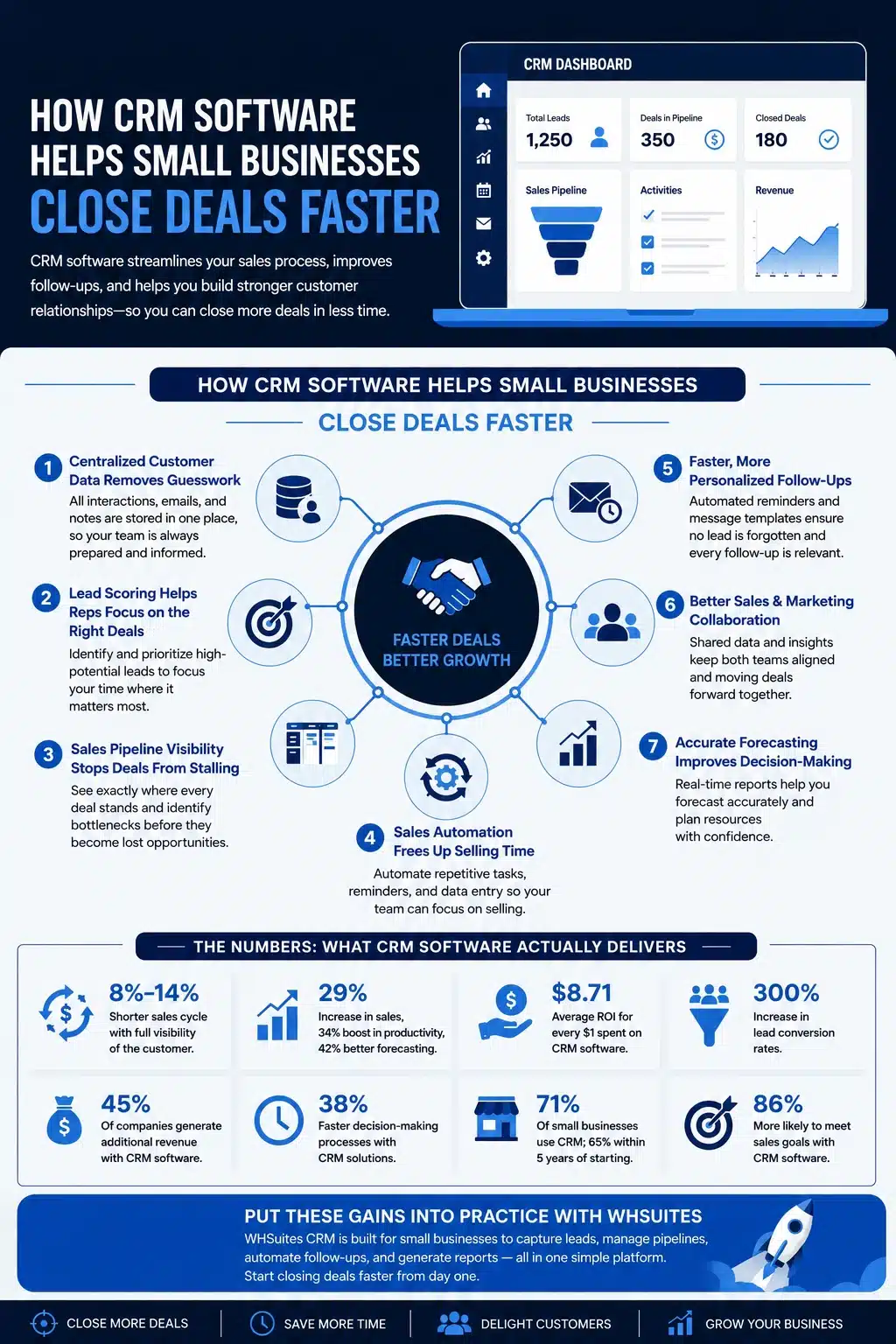
1. Centralized C₹ustomer Data Removes Guesswork
CRM programs create a database with all interaction, emails and informal talking in one document. The representatives of the sales department do not need to search for background information to be ready to do the deal.
2. Lead Scoring Helps Reps Focus on the Right Deals
Not all leads need the same approach. A CRM system helps to identify those leads that require attention.
3. Sales Pipeline Visibility Stops Deals From Stalling
The visual sales pipeline shows not just where all deals are sitting, but also which ones haven’t made a move in a while. This visibility means that bottlenecks are caught and removed before cold deals are made, which is among the main reasons CRM users report shortened sales cycles.
4. Sales Automation Frees Up Selling Time
Manual work such as data input, reminders, and repetitive tasks are precious hours for salesmen. All that work is automated by the CRM software, thus allowing salesmen to spend more time actually communicating with prospects.
5. Faster, More Personalized Follow-Ups
Automated messages and various templates for messages reduce the number of forgotten leads. Agents are able to tailor the message based on the actual buying behavior of prospects stored in the CRM accounts.
6. Better Sales and Marketing Collaboration
With the help of CRM platforms sales and marketing departments know everything about the motion of leads. This helps to avoid the duplication of calls and missed messages, which greatly slows down the deals.
7. Accurate Forecasting Improves Decision-Making
The up-to-the-minute reporting in your CRM lets you know which deals are on the verge of closing, allowing small businesses to create resource plans without guesswork. Sales managers can also train their representatives better when they know the most urgent deals.
The Numbers: What CRM Software Actually Delivers
These metrics matter when evaluating the effectiveness of CRM systems, which help companies improve their sales cycle performance:
- CRM software provides companies with the means to cut their sales cycle by between 8% and 14% because salespeople get a full understanding of the customer.
- Businesses using CRM solutions report an average increase in sales of 29%, in productivity of 34%, and better predictions of sales volume by 42%.
- Small companies can expect an average ROI of $8.71 for every dollar spent on a CRM solution, according to Nucleus Research.
- The introduction of CRM helps organizations savor an increase of up to 300% in lead conversion rates.
- Capterra states Forty five percent of companies claim that they have generated extra income thanks to CRM software.
- According to Deloitte, CRM solutions speed up business decision making processes by as much as 38%.
- Seventy one percent of small businesses are already using CRM solutions, with 65% implementing them within five years after setting up their operations, as per Nutshell.
- Companies using CRM applications are 86% more likely to meet their sales targets than those that do not use that kind of software.
How WHSuites Helps You Put These Gains Into Practice
We designed WHSuites CRM to accommodate the daily routines of small businesses which include lead capturing, pipeline management, automatic tracking of leads, and reporting. Companies don’t have to bear unnecessary complexities and expenses. WHSuites gives management the ability to gather deals, leads, and communications all in one system allowing staff to take actions right from the first day of using the tool.
Frequently Asked Questions
1. Can CRM software really help my small business close deals faster?
Absolutely! CRM software assembles all the information on clients, relieves them from tedious admin work and provides full visibility into final stages of the selling process which helps prevent possible losses of deals. Statistics show that companies using CRM tools manage to accelerate their sales cycle by 8 to 14 percent on average.
2. How long does it take to see results after implementing a CRM?
Usually, problems such as disorganized leads and slow response times are solved within three months after the implementation of a CRM.
3. Is CRM software worth the cost for a small business, or is it just for big companies?
Even small enterprises find it worthwhile to invest in CRM systems, which are believed to give $8.71 as return in investment per each dollar spent. 71% of small businesses are said to use CRM programs, some of them having adopted them within the first five years after establishment.
4. What’s the difference between using a CRM and just using spreadsheets to track leads?
The fact that spreadsheets do not carry out lead scoring, automate deal followups or notice stagnant deals means that your ability to process leads diminishes as their influx increases. In turn, CRM systems allow for all of these tasks and provide such information to all team members so that they can see what exact stage any deal is at and why the use of such systems gives an incredible advantage in terms of conversion rates of leads.
5. Which CRM features actually help close deals faster, not just organize data?
The speed-enhancing features include lead scoring tools that enable tracking all steps a deal goes through, monitoring the pipeline, reminding about follow-ups and automating administrative tasks.