
Have you ever searched for business software? If yes, you may have come across ERP & CRM software and felt confused about which one to choose. A large number of businesses invest a large capital in software, hoping it will “fix everything” and later realize that they chose the wrong tool. Are you also confused between ERP and CRM Software? Don’t worry! Here, WHSuites will provide you with everything you need to know about ERP Vs CRM Software, their key differences, and which one is better for your business.
You should know that choosing the wrong business software can cost companies more than just money; it can also affect the overall business performance, such as it can slow growth, frustrating teams, and driving customers away. Businesses that prioritize CRM have seen better customer retention, higher sales productivity, and faster returns as compared to ERP first adopters. That is the reason why understanding the ERP and CRM Software is crucial to enhancing the overall performance and efficiency of your business.
What are the Key Statistics About Market Trends of ERP and CRM Software?
According to The Business Research Company, the Global CRM software market was estimated somewhere around $247.22 billion in 2024 and expected to reach $287.26 billion in 2025. Also, it is expected to grow at a compound annual growth rate (CAGR) of 17% and reach around $539 billion by the end of 2029. On the other hand ERP software market was estimated somewhere around $64.83 billion in 2024, reaching around $70.99 billion in 2025, and growing continuously at a CAGR of 11.7% toward $123.41 billion by 2030, as per Grand View Research.
Statista estimates that the Indian CRM Software market will grow to approximately USD 1.45 billion by 2025 with a Compound Annual Growth Rate (CAGR) of 12.7%. This market is expected to be valued at approximately USD 2.65 billion by 2030. Grand View Research also estimates that the Indian ERP Software Market will be valued at approximately USD 2.73 billion in 2024, with a CAGR of 16.3 % and it is expected to be approximately USD 2.65 billion by the end of 2030.
Understanding ERP Software
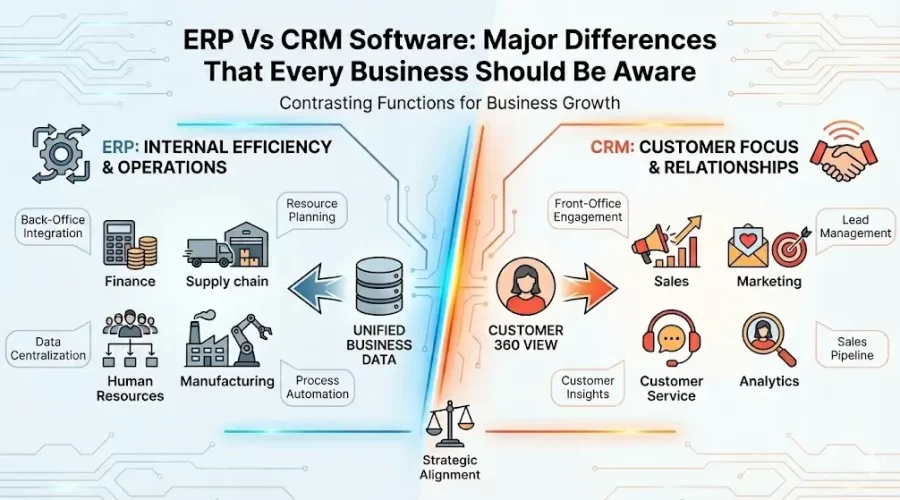
The purpose of an ERP software system is to manage internal activities of the business to interact and run from one platform. ERP software connects all the departments to ensure that throughout the organization, the data flow remains consistent.
Key Benefits Of An ERP Software System Are:
- Management of Internal and Back Office Processes
- Integrating Departments such as Finance, HR, Inventory, and Supply Chain
- Single Source Of Truth For Operational Data
- Increased Efficiency, Accuracy & Process Controls
- Cost Reductions through Automated Processes and Standardized Processes
- Primarily Used By Finance, Operations & HR Teams
- Best Used By Large, High Volume Organizations.
What Is CRM Software?
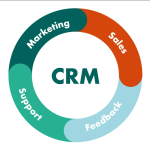
CRM Software (Customer Relationship Management) focuses on the management and support of customer relationships throughout the entire cycle of sales, marketing, and service.
Key Benefits of CRM Software are:
- Assist businesses in understanding their customers
- Centralizes the collection, management, and communication of customer data
- Aids in tracking leads, sales pipeline, and following up with customers
- Supports marketing campaigns and customer engagement
- Improves customer retention and satisfaction
- Allows you to sell more quickly and to make better decisions
- Utilized by sales, marketing, and customer support teams
What are the Main Differences Between ERP and CRM software?
Here are some of the key differences between SRP and CRM, which include the following:
| Aspect | ERP Software | CRM Software |
| Primary Focus | Internal business operations | Customer relationships and interactions |
| Main Purpose | Improve efficiency and control costs | Increase sales and customer retention |
| Business Area | Back-office processes | Front-office activities |
| Key Functions | Finance, Inventory, HR, and Supply Chain | Leads, Sales, Marketing, and Customer Support |
| Primary Users | Finance, Operations, and HR teams | Sales, Marketing, and Support teams |
| Data Managed | Financial and operational data | Customer and sales data |
| Revenue Impact | Indirect | Direct |
| Implementation | Complex and time-consuming | Faster and easier |
| Best For | Large or operation-heavy businesses | Growth-focused and service-based businesses |
ERP vs CRM: What the Data Says About ROI & Growth
Here is what the data says about ROI & Growth of ERP and CRM, which includes the following:
| Aspect | ERP (Enterprise Resource Planning) | CRM (Customer Relationship Management) |
| Primary Focus | Internal operations and process optimization | Customer engagement, sales, and retention |
| Main Growth Driver | Cost reduction and operational efficiency | Revenue growth and customer lifetime value |
| Average ROI | Approx 52% on average, with studies showing ranges from 150% to 400% plus over time | Approx $8.71 return for every $1 invested, with returns reported up to 245% to 336% over 3 years |
| Time to ROI | Typically 1 to 3 years | Often within 12 months |
| Revenue Impact | Indirect (improved margins and cost control) | Direct (higher sales and retention) |
| Efficiency Gains | 66% report increased efficiency and 78% improved productivity | 34% improvement in sales productivity |
| Cost Optimization | 62% report reduced costs and 91% optimized inventory levels | 91% report reduced customer acquisition costs (CAC) |
| Decision-Making Impact | 60% see better decisions through real-time data | 42% improvement in sales forecast accuracy |
| Customer Impact | Limited, mostly indirect | Up to 27% improvement in customer retention |
| Typical Users | Finance, operations, supply chain, and manufacturing teams | Sales, marketing, and customer support teams |
Which Is Better for Your Business? – ERP or CRM
Choose ERP If:
- You need strong control over finance, inventory, HR, and operations
- Your business is large or process-heavy
- Efficiency, compliance, and cost control are top priorities
- You want centralized operational data across departments
Choose CRM If:
- Your focus is on sales growth and customer retention
- You manage leads, pipelines, and customer interactions
- You want faster ROI and easier implementation
- Your business is service-based or growth-focused
ERP + CRM Together: Do You Need Both?
Yes, Most of the companies, from small and midsize businesses, need both an ERP for back office operations (finance & inventory) and a CRM system for front office sales/service. Integrating these software is key for seamless data flow, efficiency, and better decision-making and planning for future integration.
Final Verdict: ERP vs CRM — The Smart Choice in 2025
To sum up everything that has been stated so far, the above given information on the topic “ERP Vs CRM Software” states some of the major differences between these two software and why they are crucial for every business. If you are looking for effective CRM Software, visit WHsuites’ website today!
Note – ERP ≠ CRM
- ERP = operational efficiency
- CRM = revenue growth
People Also Ask About the Difference Between ERP and CRM Software
Question 1. What is the key difference between ERP and CRM software?
Answer. The main difference between ERP and CRM software is their focus, because ERP software focuses on internal operations of a business, whereas CRM software focuses on customer interactions.
Question 2. Does ERP have a greater impact on the business environment than CRM?
Answer. No, while ERP systems focus on the internal organization of a company, CRM software has a greater impact on the revenue generated through the management of leads, developing relationships, and conversion rates.
Question 3. What makes CRM software more popular than ERP in India?
Answer. CRM software is more popular than ERP due to the fact that the majority of Indian companies are focused on acquiring and retaining customers and generating revenue. CRM systems are less expensive and easier to implement than traditional ERP systems.
Question 4. Do small & medium-sized businesses need ERP or CRM software?
Answer. Most of the small and mid-sized businesses need CRM software because it is easier to implement, more affordable, and delivers faster ROI as compared to ERP, which is typically more suitable for large businesses with complex operational needs.
Question 5. Can CRM software increase the revenue of my business?
Answer. Yes, CRM software can help businesses improve revenue by improving lead management, shortening the sales cycle, and enhancing customer retention.
Question 6. How do I decide if my business needs ERP or CRM?
Answer. You should choose CRM if you want to boost sales, improve customer relationships, and increase revenue, and you should choose ERP if you need centralized operations, finance automation, and internal processes controlled.
Question 7. Which of the software among ERP or CRM, is better for healthcare businesses?
Answer. CRM software is typically a better choice for healthcare businesses as it helps to manage patient relationships, appointments, and follow-ups.
Question 8. Is cloud-based CRM better than traditional ERP systems?
Answer. Yes, cloud-based CRM systems are often more flexible, scalable, and cost-effective, whereas traditional ERP systems require more investment and longer deployment time.