Manufacturing businesses don’t have to manage only production; they also need to manage more than that. Businesses have to monitor and track each and everything from generating leads to monitoring production schedules, and delivering orders on time. If any of the factors are not evaluated properly, it can affect the business performance.
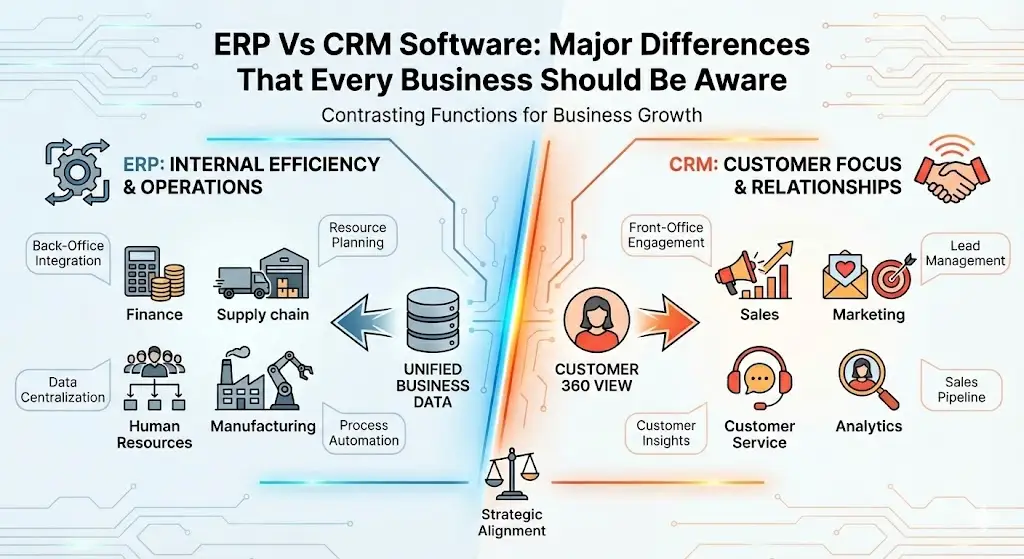
Here is a comparison of CRM vs ERP for manufacturing. Here you will get to know the difference between Customer Relationship Management (CRM) and Enterprise Resource Planning (ERP) software. Let’s understand the differences, benefits, and factors that can help you choose the right solution among CRM and ERP.
Manufacturing CRM software helps manufacturers manage their relationships with potential buyers, existing customers, distributors, dealers, and other business partners. This software brings customer information, sales activities, quotations, and follow-up schedules into one centralised platform.
A manufacturing CRM can help automate and organize multiple activities. With this feature of the CRM, your sales team can focus on converting enquiries into orders and maintaining long term customer relationship. You need to look at the features of manufacturing CRM software to simply understand the difference between CRM and ERP software.
Lead management
Sales pipeline management
Automated follow-ups
Dealer and distributor management
Quotation management
Sales reporting and analytics
After-sales support
Businesses that are looking to improve sales coordination can consider WHSuites CRM for Manufacturing Business. With WHSuites CRM, businesses can benefit from its multiple features, including lead management, automated follow-ups, field sales tracking, and most importantly customer relationship management.
ERP Software for Manufacturing:
Manufacturing ERP software help businesses manage and connect different internal functions that is necessary for running a manufacturing business. ERP allos the manufacturer not only to gain customers but also to complete orders effectively while monitoring their costs and resources. Key Features of Manufacturing ERP Software
Production Scheduling
Inventory Control
Procurement Control
Supplier Control
Order and Delivery Management
Financial Management
Analytics and Reporting
Manufacturers can check WHSuites ERP Software for Manufacturing Industry to see how efficiency and unity of business processes can help in the organization of production, management of inventory and suppliers, and business reporting.
Why Do Manufacturing Businesses Require CRM and ERP?
For many expanding manufacturing companies, implementing both systems can be beneficial because sales and operations are interdependent. When you get a customer, it is not just the first step, next steps are waiting for you. The company also has to manufacture the number of products as per the client’s requirements and deliver the product. What is the reason that manufacturing businesses require CRM and ERP? Below is the answer.
Connecting Sales Commitments and Production Capacity
Enhance Order Processing and Coordination
Achieve Better Inventory Visibility
Enhancing Client Communications
Facilitate Better Business Choices
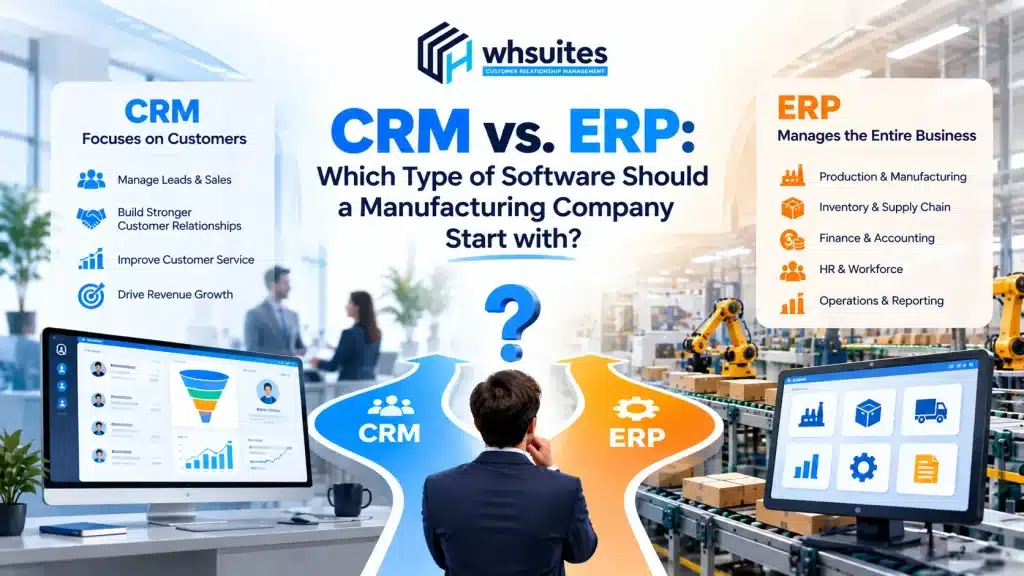
CRM vs. ERP: Which Type of Software Should a Manufacturing Company Start with?
It can be difficult decision to pick the right software for your business. But it is the difficult decision till you have less knowledge of CRM and ERP, when you understand the different between the both and find out which one is profitable for your business. It is one of the easiest decisions. Now let us understand which type of software a manufacturing company should start with:
The decision of finding the right software start with the challenges that should be solved first. It does not mean that both programs should be implemented at once or together. Find the right way to pick the right choice.
Start with CRM If Sales Management Is Your Company’s Top Challenge
A company should start with CRM if it:
Loses enquiries because sales representatives forget to follow up
Finds it difficult to maintain consistent communication with existing customers
Has limited visibility into quotations and conversion rates.
Struggles to monitor field sales teams and distributor relationships.
CRM can be beneficial for your business in streamlining sales operations and creating a consistent follow up process.
Start with ERP When the Main Challenge is the Need for Operational Efficiency
If your manufacturing company suffers from the following:
Stock shortages or excess inventory.
Difficulties with raw material procurement and scheduling production.
Use of disconnected records in the warehouse, purchasing, and finance.
Inability to track operating costs successfully.
Challenges with getting timely and reliable information from different departments.
Implementing an ERP system can create a sounder operational base through connecting vital business processes.
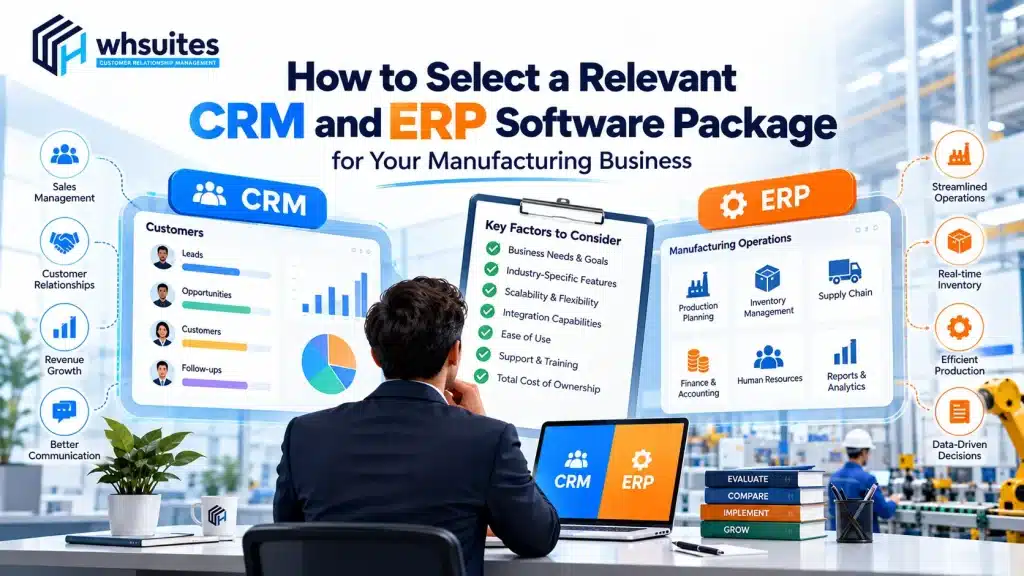
How to select a relevant CRM and ERP software package for your manufacturing business
When choosing production management software, pay attention to your current operations and future needs.
Assess the operational gaps of your business.
Look for some specific features.
Check connection capabilities.
Consider the convenience and scalability of the system.
Compare the price.
Check access and reporting.
WHSuites offers both ERP and CRM solutions to manufacturing companies, enabling them to manage both customers and procedural activities through one software program. Look through the manufacturing ERP and CRM solutions in order to understand which capabilities are more suitable for your needs.
Final Thoughts
When choosing between CRM or ERP for manufacturing, your decision is not about which option is better. It’s about how to understand your requirements and find a suitable solution for them.
If your difficulties have to do with sales management, you should start with a CRM system. On the other hand, if production and resource planning are the areas to address, you should start with ERP. Moreover, if you are facing problems in both processes, you might consider using an integrated approach, with specific definitions of workflows and responsibilities for data.
The idea of all of this is simple: create a smooth-running manufacturing business that connects commitments to customers, current resources, and operational decisions.
Frequently Asked Questions:
What is the difference between CRM and ERP with respect to manufacturing?
CRM handles customer relationships, sales leads, quotations, and follow-ups, whereas ERP controls the internal processes in the company, including production, inventory, purchasing, and finance.
Do manufacturing firms require both CRM and ERP systems?
While not all manufacturing firms require both systems right away, as businesses with complex sales processes and operational workflows will benefit from both systems. However, it will depend on the size of the business, the complexity of its processes, other software the business is using, budget and the issues it has to deal with.
Is it possible to manage manufacturing inventory using CRM?
In some cases, manufacturers can rely on CRM for storing product information and answering customer queries. Stock control is usually considered a part of ERP responsibilities. Yet, there can be some overlapping of features on some platforms, which is why manufacturers have to check whether they will be able to manage their inventory with the system they choose.
Can ERP substitute for manufacturing CRM?
ERP can cover the most basic needs of customers, including keeping customer records and order processing. However, it will not provide specialized services like lead nurturing, sales pipeline tracking, campaign management and follow-up automation. That is why the answer depends on the functions that ERP has.
In what manner does CRM and ERP integration assist manufacturers?
The use of CRM and ERP helps integrate critical sales and operational data for the creation of coordinated sales orders, inventory needs, and shipping expectations. It improves the operations by reducing the amount of repeated data input and providing greater visibility in terms of making better decisions through correct data synchronization.
For a small manufacturing company, which solution should it implement first: CRM or ERP?
Small manufacturers should focus on implementing the system that provides solutions to the biggest issue at hand. If the company experiences losing potential clients along with irregular follow up, then it should implement CRM. In the case of problems with stock management, production, and purchasing, implementing ERP would be more reasonable. It is crucial to start with precise requirements and limited scope.