

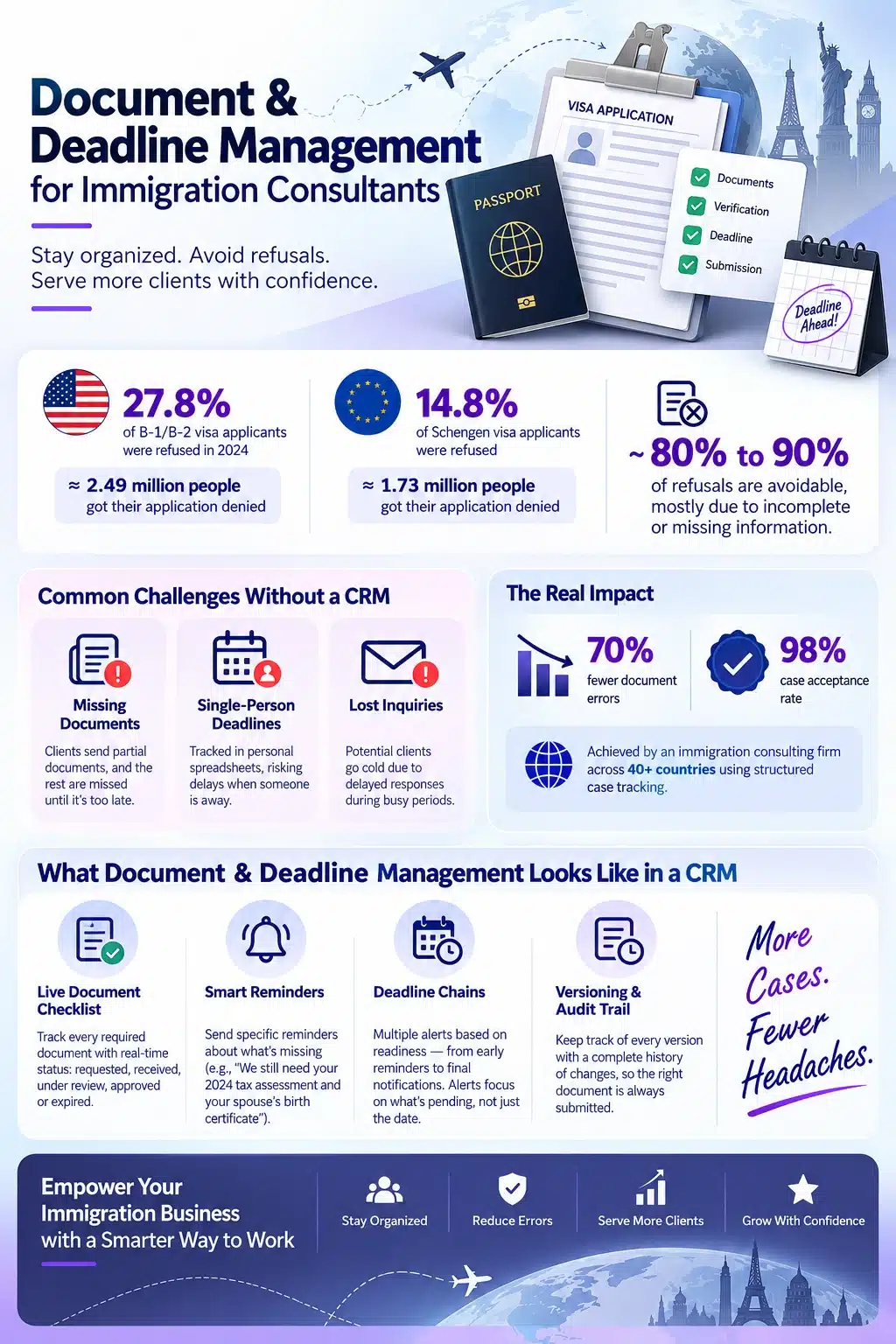
Those who are involved in running an immigration firm know that giving advice is the easy part. The difficult part is managing paperwork, since every case comes with a tight deadline. In the fiscal year of 2024, as 27.8% of those who applied for a B-1/B-2 visa were refused, nearly 2.49 million people worldwide got their application denied, as per Travel.State.Gov. Meanwhile, Schengen countries refused visas to 14.8% of their applicants or 1.73 million people. The matter is that this is a common case for all types of visas; the majority of refusals (about a third of them) are due to applications that lack relevant information. It is estimated that 80% to 90% of refusals are avoidable in the first place.
The majority of refusals are not due to eligibility, but because some bank statements do not get stuck to the application or no one ever looks at a passport page. In some cases, the filing window may also be closed by the time the application is finally submitted. At the present time, Document & deadline management is not viewed as an administrative burden by immigration consulting firms; it has turned into the very value they provide.
Why Document Management Makes or Breaks a Case
A single complex immigration case may include dozens of documents like passports, financial documents, letters of employment, translated qualifications and proof of sponsorship. Each document may have its own rules, timeframes and formats. When these documents are all over the place, in email threads, shared folders and WhatsApp messages, you are the only person responsible for managing them. This approach does not hold for large amounts of documents. Above the fact that even if done correctly, one small mistake can ruin the application, one document or an expired version can ruin the case.
This is exactly where companies that invested in the structure of immigration case tracking used their advantage. One immigration consulting firm implemented validation and case tracking and decreased errors in documents by 70% while maintaining 98% acceptance of cases in more than 40 countries, which cannot be achieved by simple storage.
Where a Spreadsheet and Inbox Stop Working
Many practices will get by here but only until they have approximately 20 active files at a time. It is always in the same three places where it fails:
- An important document everyone didn’t realize was missing. The client sent an email containing 4 of 9 documents needed, while no one bothered to get the other 5 until the deadline arrived and the awkward phone call had to be made.
- The deadline that can be seen only by one person. A filing window laid out in a personal Excel file becomes a single point of failure, should this person go on vacation, the matter is at risk.
- An inquiry that has gone cold. The potential client’s inquiry comes in during a number of back-to-back meetings and misses a reply.
A general-purpose inbox was not supposed to manage this. CRM designed to sort clients’ files was made to do exactly this.
What Real Document & Deadline Management Looks Like in a CRM
If you want to truly understand how good CRM automation actually works in an immigration law firm, take away the marketing hype and think about a few capabilities that make CRM great:
1. A live document checklist, not a static one
Every document needed (by type of visa and person) is included on the case with its latest status: requested, received, under review, approved or expired. You can see what is outstanding in real time without opening a case file to find out.
2. Reminders that name what is actually missing
The biggest improvement available is the simplest one stop sending the full list of documents over and over again. When a client gets “We still need your 2024 tax assessment and your spouse’s birth certificate”, they will do something. The same client receiving the same nine-item list again will just ignore it, feeling being controlled by the immigration lawyer’s office.
3. Deadline chains — not single alerts
If one misses an immigration filing period, it does not result in a fee but rather loss of status and separation from their loved ones. This makes the meaning of “acceptable keeping track of deadlines” quite different. The good practice is built upon multiple reminders about deadlines: early reminders are used to gather documents, reminders closer to the deadline remind about urgent actions and final notification cannot go unnoticed. It is essential to make sure that the notification is related to readiness but not simply to the date on the calendar. If the filing period is six weeks away and documentation is ready, the alert is unnecessary. In case three documents are still missing, there is a need to pay attention to the issue.
4. Versioning and an audit trail
Clients provide new bank statements, translations or forms. If there is no history of versioning, a client might submit an old version of the document. The submission of the document is especially big deal in terms of getting someone’s legal status.
5. A secure client portal, not WhatsApp
Passport copies, financial documents, and personal information of family members are some of the most important pieces of information handled by companies. Controlled uploading, secure storing of information, and clear retention policy should be considered as must-have features for compliance-related companies, not as extras.
The Part Most Practices Never Measure
Immigration customers want to get status reports much more often than customers in other businesses, but this is usually not due to impatience, rather to fears regarding the case where their lives depend on the outcome. There exist firms that maintain clients updated on a regular basis without waiting until clients ask for them to do so; thus, a practice can be defined of reducing questions regarding the status of a client as numerous hours are wasted on answering a repetitive question instead of solving real issues. If there exists only one index that should be taken into account after a business has turned to a CRM system, it should be the number of hours spent on giving status reports instead of catching up with other more important activities.
How WHSuites Supports Document & Deadline Management
WHSuites consolidates all client information, communication and documentation processes into one case thread rather than different inboxes and countless chat apps. CRM for immigration consultants, means:
- There is only one case file for every client containing all documents, communications, important dates and decision making processes, no need to search across multiple platforms anymore.
- All reminders for missing files are automated – no longer dependent on a person remembering that something was not done.
- All deadlines are tracked with notifications about the status and readiness of a case. Immediate warnings can be received when there is a case with a gap in the filing time.
- There is only one secure platform for storing sensitive clients’ documents and that is different from e-mail and WhatsApp.
Even though the project-related information (government forms, applications, other compliance documents) has to be stored in the specialized software, WHSuites deals with all operations surrounding it: information gathering, reminders, notifications, and communication.
The Takeaway
Immigration agencies have a consistent winning record regarding legal rulings. What they fail in is administration — documents not filed enough times, deadlines only known by some, clients who ask one question too many because no one bothered to inform them. As already denied visa applications have a rejection rate of 14% to 28% across major categories and a majority of such cases involve document management failures rather than the candidate’s failures, this means that tight deadlines and proper document management are a must.
FAQs About Document & Deadline Management
1. Why do immigration consultants need document management software instead of just Google Drive or email?
Simple, they might store a document, but will not know if, for example, a bank statement is missing, a passport is about to expire or document is the wrong version — all they do is give you the folder for storing files and a mental checklist of things to do.
2. How can a CRM help immigration consultants stop missing filing deadlines?
The consultant can track deadlines for the client’s documents since warnings are given about readiness instead of mere dates. If there is a deadline coming up in six weeks and the consultant is already ready with the paperwork, that is sufficient. However, if there are missing documents, the case is flagged and the consultant must act upon it.
3. What’s the best way to follow up with clients who haven’t sent their documents?
It is best to only indicate what is still outstanding and not repeat all items needed. Clients will respond to being told that there are still Ed and Jane missing and would not want to listen to the whole original list of items needed.
4. Can a CRM replace regulated immigration case management software?
A CRM cannot and should not replace such software as all actions are regulated through the case management software, making the entire program compliant with the law. Just the CRM handles the document collection and deadlines on top of maintaining communication with the clients.
5. How much of visa application rejection is actually caused by missing or incomplete documents, not eligibility?
Yes, it is. Industry estimates suggest that incomplete and erroneous applications account for around one-third of denials and experts believe that 80% to 90% of refusals are avoidable. Therefore, the main issue is related to paperwork.
6. Is it safe to send client documents like passports over WhatsApp or personal email?
No, it is not. Passports, financial documents, and details about families are very sensitive information and it is impossible to control access and monitor telecommunications via WhatsApp or personal email. The better option is to use a secure and access-controlled client portal which is becoming a standard in the industry.
7. How do I know if switching to a CRM for document and deadline tracking is actually working?
Monitor the number of questions clients send you instead of checking how nice your case list is. When clients stop annoying you with calls for updates, you realize that your proactive communication has worked and you have more hours in your hands.